
Find Help
More Items From Ergsy search
-
Is AI technology in lung cancer detection widely accepted by hospitals?
Relevance: 100%
-
How are AI and Robots used to detect lung cancer?
Relevance: 68%
-
How do AI algorithms detect lung cancer in scans?
Relevance: 67%
-
What role does AI play in lung cancer detection?
Relevance: 65%
-
What is the advantage of using AI for lung cancer detection?
Relevance: 65%
-
How does AI impact the cost of lung cancer detection?
Relevance: 65%
-
What is the future of AI and robotics in lung cancer detection and treatment?
Relevance: 64%
-
Are there ethical considerations in using AI for lung cancer detection?
Relevance: 63%
-
Have AI systems for lung cancer detection been clinically validated?
Relevance: 62%
-
Which types of imaging data are analyzed by AI for lung cancer detection?
Relevance: 59%
-
What challenges remain in using AI for lung cancer detection?
Relevance: 58%
-
Can robots perform lung cancer screenings?
Relevance: 54%
-
What is a low-dose CT scan for lung cancer?
Relevance: 53%
-
Are there any AI-based tools available for lung cancer risk assessment?
Relevance: 52%
-
Are AI systems used alone in lung cancer diagnosis or alongside human radiologists?
Relevance: 50%
-
Can AI systems reduce the rate of false positives in lung cancer screening?
Relevance: 50%
-
Do AI models for lung cancer require a lot of data to train?
Relevance: 49%
-
Can AI help in monitoring lung cancer progression?
Relevance: 49%
-
How can AI improve patient outcomes in lung cancer?
Relevance: 46%
-
Air Pollution and Lung Cancer
Relevance: 46%
-
How do AI-assisted robotic systems enhance lung cancer surgeries?
Relevance: 46%
-
Can AI predict lung cancer survival rates?
Relevance: 43%
-
Does the NHS offer an online hospital for prostate cancer?
Relevance: 39%
-
Can a womb lining test detect cancer?
Relevance: 36%
-
Can a womb lining test detect cancer?
Relevance: 36%
-
Does the NHS offer an online hospital for prostate cancer?
Relevance: 35%
-
Prostate cancer symptoms - detecting them early
Relevance: 35%
-
What kinds of cancer screening are available?
Relevance: 31%
-
How do water companies detect leaks?
Relevance: 29%
-
What is cancer screening?
Relevance: 29%
-
How is dangerous driving detected by police?
Relevance: 28%
-
AI Breast Cancer Screening in the UK
Relevance: 28%
-
Radiotherapy Services at University Hospital
Relevance: 28%
-
Bernard's Story - Lung Transplant
Relevance: 28%
-
How common is bowel cancer?
Relevance: 27%
-
How are new technologies helping to reduce water loss in the UK?
Relevance: 27%
-
What are the symptoms of testicular cancer?
Relevance: 27%
-
What is Cancer?
Relevance: 27%
-
Can bowel cancer spread to other parts of the body?
Relevance: 27%
-
Can technology help in blocking the camera's view?
Relevance: 27%
Introduction to AI in Lung Cancer Detection
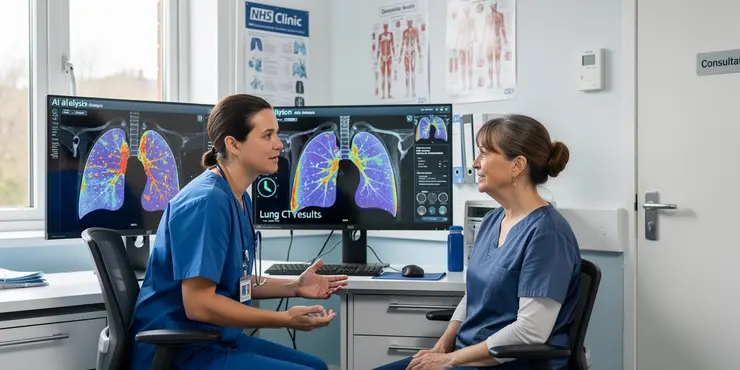
Artificial intelligence (AI) technology has shown promise in advancing medical diagnostics.
In the UK, its application in detecting lung cancer is gaining interest among healthcare professionals.
Current Adoption in UK Hospitals
Some UK hospitals have begun trials integrating AI for lung cancer detection.
However, widespread adoption is still limited due to various factors.
Benefits of AI in Cancer Detection
AI systems can analyze imaging data faster than human radiologists.
This quick analysis can lead to earlier detection of lung cancer.
Early detection often results in better treatment outcomes for patients.
Challenges Faced by Hospitals
One major challenge is the integration of AI technology into existing systems.
Another concern is the high cost associated with implementing new AI solutions.
There are also concerns about the accuracy and reliability of AI diagnoses.
Trust and Acceptance Among Medical Professionals
Some healthcare professionals remain skeptical about AI's effectiveness.
Building trust in AI technology requires further successful trials and validation.
Future Prospects for AI in Cancer Detection
As AI technology improves, it's likely that more hospitals will adopt it.
Government initiatives and funding could accelerate widespread implementation.
Continued research and collaboration between tech companies and hospitals are crucial.
Conclusion
AI technology has the potential to revolutionize lung cancer detection in the UK.
While there are challenges, ongoing advancements offer hope for broader acceptance.
Frequently Asked Questions
What is AI technology in lung cancer detection?
AI technology in lung cancer detection involves using artificial intelligence algorithms to assist in identifying and diagnosing lung cancer from medical images such as CT scans more efficiently.
How does AI improve lung cancer detection?
AI can enhance lung cancer detection by rapidly analyzing medical images for abnormalities, improving the accuracy of initial screenings, and reducing the workload on radiologists.
Are hospitals widely accepting AI for lung cancer detection?
The acceptance of AI technology for lung cancer detection is growing, but it is not yet universal. Many hospitals are in various stages of evaluating or integrating AI solutions.
What are the benefits of AI in lung cancer diagnosis?
AI can provide faster diagnosis, improved accuracy, consistency in readings, and assist in early detection, which can lead to better patient outcomes.
Have studies shown AI to be effective in detecting lung cancer?
Yes, multiple studies have demonstrated that AI systems can match or even surpass human radiologists in the accuracy of reading and detecting lung cancer from scans.
What are the challenges facing AI adoption in lung cancer detection?
Challenges include the need for large datasets for training, integration with existing systems, regulatory approvals, and gaining trust among healthcare professionals.
Do all hospitals use the same AI systems for lung cancer detection?
No, hospitals may choose from different AI solutions based on their specific needs, budgets, and infrastructure compatibility.
Is AI alone responsible for diagnosing lung cancer?
No, AI acts as a decision support tool that aids radiologists in diagnosing lung cancer, but it does not replace human expertise.
What role do radiologists play when using AI for lung cancer detection?
Radiologists are responsible for interpreting AI findings, combining them with clinical information, and making the final diagnosis.
Are there any regulatory concerns with using AI in medical diagnoses?
Yes, regulatory bodies like the FDA must approve AI systems for clinical use, and they must be continually monitored for safety and efficacy.
How does AI help in early detection of lung cancer?
AI can analyze large volumes of data quickly, identifying subtle patterns and early signs of cancer that might be missed by human eyes.
Do patients benefit directly from AI in lung cancer detection?
Yes, patients can benefit from quicker diagnoses, potentially less invasive testing, and earlier treatment interventions.
Are there specific AI algorithms designed for lung cancer detection?
Yes, several AI algorithms have been specifically developed and trained to identify lung cancer characteristics in imaging data.
What data does AI use for analyzing lung cancer?
AI typically uses data from medical imaging such as CT and X-ray scans, and sometimes integrates electronic health records for enhanced analysis.
Are there hospitals that have reported improved outcomes using AI for lung cancer detection?
Yes, some hospitals have reported improvements in detection rates and workflow efficiency after implementing AI systems.
Have there been cases of AI missing lung cancer diagnoses?
While AI is highly accurate, it is not infallible and there have been instances of missed diagnoses, underscoring the need for human expertise in the review process.
How do hospitals choose an AI system for lung cancer detection?
Hospitals often consider factors such as algorithm accuracy, ease of integration, cost, vendor support, and existing infrastructure.
Can AI systems be updated or improved over time?
Yes, AI systems can be continuously trained and updated with new data to improve their accuracy and performance.
Is there a cost advantage to using AI in lung cancer detection?
AI can potentially reduce costs by improving workflow efficiency and decreasing the need for follow-up tests due to improved initial accuracy.
What is the future outlook for AI in lung cancer detection within hospitals?
The future looks promising, with more hospitals expected to adopt AI for lung cancer detection as technology advances and its benefits become more widely recognized.
Useful Links
This website offers general information and is not a substitute for professional advice.
Always seek guidance from qualified professionals.
If you have any medical concerns or need urgent help, contact a healthcare professional or emergency services immediately.
- Ergsy carfully checks the information in the videos we provide here.
- Videos shown by Youtube after a video has completed, have NOT been reviewed by ERGSY.
- To view, click the arrow in centre of video.
- Most of the videos you find here will have subtitles and/or closed captions available.
- You may need to turn these on, and choose your preferred language.
- Go to the video you'd like to watch.
- If closed captions (CC) are available, settings will be visible on the bottom right of the video player.
- To turn on Captions, click settings .
- To turn off Captions, click settings again.
More Items From Ergsy search
-
Is AI technology in lung cancer detection widely accepted by hospitals?
Relevance: 100%
-
How are AI and Robots used to detect lung cancer?
Relevance: 68%
-
How do AI algorithms detect lung cancer in scans?
Relevance: 67%
-
What role does AI play in lung cancer detection?
Relevance: 65%
-
What is the advantage of using AI for lung cancer detection?
Relevance: 65%
-
How does AI impact the cost of lung cancer detection?
Relevance: 65%
-
What is the future of AI and robotics in lung cancer detection and treatment?
Relevance: 64%
-
Are there ethical considerations in using AI for lung cancer detection?
Relevance: 63%
-
Have AI systems for lung cancer detection been clinically validated?
Relevance: 62%
-
Which types of imaging data are analyzed by AI for lung cancer detection?
Relevance: 59%
-
What challenges remain in using AI for lung cancer detection?
Relevance: 58%
-
Can robots perform lung cancer screenings?
Relevance: 54%
-
What is a low-dose CT scan for lung cancer?
Relevance: 53%
-
Are there any AI-based tools available for lung cancer risk assessment?
Relevance: 52%
-
Are AI systems used alone in lung cancer diagnosis or alongside human radiologists?
Relevance: 50%
-
Can AI systems reduce the rate of false positives in lung cancer screening?
Relevance: 50%
-
Do AI models for lung cancer require a lot of data to train?
Relevance: 49%
-
Can AI help in monitoring lung cancer progression?
Relevance: 49%
-
How can AI improve patient outcomes in lung cancer?
Relevance: 46%
-
Air Pollution and Lung Cancer
Relevance: 46%
-
How do AI-assisted robotic systems enhance lung cancer surgeries?
Relevance: 46%
-
Can AI predict lung cancer survival rates?
Relevance: 43%
-
Does the NHS offer an online hospital for prostate cancer?
Relevance: 39%
-
Can a womb lining test detect cancer?
Relevance: 36%
-
Can a womb lining test detect cancer?
Relevance: 36%
-
Does the NHS offer an online hospital for prostate cancer?
Relevance: 35%
-
Prostate cancer symptoms - detecting them early
Relevance: 35%
-
What kinds of cancer screening are available?
Relevance: 31%
-
How do water companies detect leaks?
Relevance: 29%
-
What is cancer screening?
Relevance: 29%
-
How is dangerous driving detected by police?
Relevance: 28%
-
AI Breast Cancer Screening in the UK
Relevance: 28%
-
Radiotherapy Services at University Hospital
Relevance: 28%
-
Bernard's Story - Lung Transplant
Relevance: 28%
-
How common is bowel cancer?
Relevance: 27%
-
How are new technologies helping to reduce water loss in the UK?
Relevance: 27%
-
What are the symptoms of testicular cancer?
Relevance: 27%
-
What is Cancer?
Relevance: 27%
-
Can bowel cancer spread to other parts of the body?
Relevance: 27%
-
Can technology help in blocking the camera's view?
Relevance: 27%


