
Speak To An Expert
Get clear, personalised advice for your situation.
Jot down a few questions to make the most of your conversation.
Vaping and public places in the UK
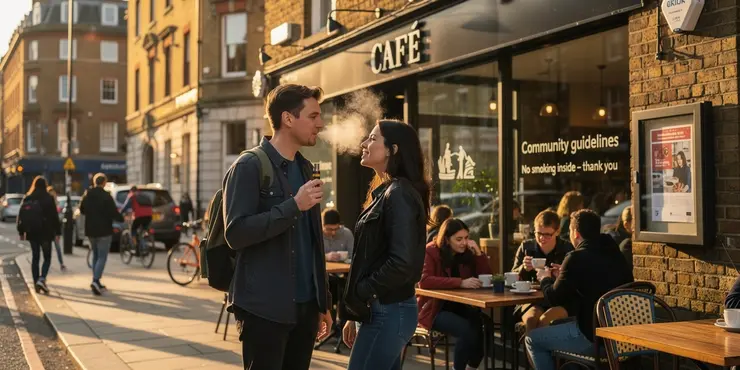
There is no single UK-wide law that bans vaping in all public places. In many areas, vaping rules are set by individual venues, employers, landlords, or local policies rather than by Parliament.
That means you may be allowed to vape in one place but not in another. The key point is to look for signs, ask staff if needed, and respect any local rules.
Where vaping is commonly restricted
Many businesses choose to treat vaping the same as smoking. This is common in shops, restaurants, pubs, offices, hospitals, public transport, and other enclosed spaces.
Train stations, airports, and some outdoor public areas may also have vape-free zones. Even where there is no legal ban, venue owners can ask you not to vape and can refuse entry or service if you do not comply.
Workplaces and employers
Employers in the UK can decide whether vaping is allowed on their premises. Many workplaces have clear policies that ban vaping inside buildings and sometimes in company vehicles too.
If you are unsure, check the staff handbook or speak to your manager. Even if smoking breaks are allowed outside, vaping may still be restricted in certain areas.
Public transport and enclosed spaces
Vaping is usually not permitted on buses, trains, trams, underground systems, or inside stations. Transport operators often include vaping in their no-smoking rules.
The same is often true for taxis, hire cars, and shared vehicles. If you are travelling, it is best to assume vaping is not allowed unless clearly stated otherwise.
Children, schools, and healthcare settings
Schools, nurseries, and many healthcare settings tend to have strict no-vaping policies. These places often ban vaping completely, including outdoor areas close to entrances.
This is partly to protect children, patients, and staff from vapour exposure and partly to set a clear example. If you are visiting one of these places, check the site rules before you go.
What the law means for vapers
In most cases, the issue is not criminal law but private rules and local policies. If you ignore them, you may be asked to stop vaping, leave the premises, or face disciplinary action at work.
Public nuisance or anti-social behaviour laws are rarely the main issue, but complaints can still arise if vaping causes disturbance. The safest approach is to treat vaping like smoking in shared spaces unless you know it is allowed.
Practical advice
Look for no-smoking signs, because many places apply the same rule to vaping. If you cannot see a policy, ask before you vape.
When in doubt, step outside and keep a respectful distance from entrances, windows, and other people. Being considerate helps avoid complaints and keeps vaping rules easier to follow.
Frequently Asked Questions
Vaping regulations in public places are the rules that limit or ban the use of e-cigarettes and similar devices in places open to the public, such as restaurants, parks, transit areas, workplaces, and other shared spaces.
Vaping regulations in public places often prohibit vaping in indoor public spaces, on public transportation, in government buildings, schools, healthcare facilities, and in some outdoor areas like stadiums or bus stops.
Vaping regulations in public places exist to reduce secondhand aerosol exposure, protect children and other bystanders, support cleaner shared environments, and simplify enforcement of smoke-free rules.
Vaping regulations in public places may mirror smoking bans, but some jurisdictions treat vaping separately and allow it in certain areas where smoking is banned, while others apply the same restrictions to both.
No, vaping regulations in public places vary by country, state, province, and municipality, so the rules in one location may be much stricter or more permissive than in another.
Yes, many vaping regulations in public places prohibit vaping in restaurants and bars, especially indoors, although some jurisdictions may allow it in designated outdoor seating areas.
Yes, many vaping regulations in public places restrict vaping in workplaces, including offices, retail spaces, factories, and other employer-controlled indoor areas, with some rules extending to company vehicles and outdoor work areas.
Yes, vaping regulations in public places commonly ban vaping on buses, trains, subways, ferries, airports, transit stations, and other transportation-related public areas.
Often yes, vaping regulations in public places are usually stricter near schools, playgrounds, youth facilities, and other places where children gather, and many locations completely prohibit vaping there.
Sometimes. Some public places like parks and beaches allow vaping in certain areas, while others ban it entirely or restrict it near playgrounds, sports fields, entrances, and crowded sections.
Yes, local governments can often create vaping regulations in public places that are stricter than state or national rules, as long as they do not conflict with higher-level laws.
Vaping regulations in public places are usually enforced by site managers, employers, security staff, transit authorities, or local officials through warnings, fines, or removal from the premises.
Penalties under vaping regulations in public places can include verbal warnings, citations, fines, confiscation in some settings, or being asked to leave the area, depending on the jurisdiction.
Yes, vaping regulations in public places generally apply to everyone in the location, including residents, visitors, and tourists, regardless of whether they are familiar with the local rules.
In some places, yes. Certain vaping regulations in public places allow designated vaping areas outdoors or in specific sections, but many jurisdictions have eliminated these exceptions entirely.
Often yes. Many vaping regulations in public places cover cannabis vape products as well as nicotine devices, although separate cannabis laws may also affect where they can be used.
Yes, private businesses commonly may set stricter vaping regulations in public places than the law requires, such as banning vaping on patios, near entrances, or throughout the entire property.
You can find the current vaping regulations in public places by checking local government websites, public health departments, transit authority rules, workplace policies, or official signage at the venue.
Yes, many vaping regulations in public places require or encourage clear no-vaping signs so that visitors know where vaping is prohibited and enforcement can be consistent.
If you are unsure about vaping regulations in public places, it is best to assume vaping is not allowed, look for posted rules, ask staff or officials, and choose a designated area if one is provided.

Ergsy Search Results
This website offers general information and is not a substitute for professional advice.
Always seek guidance from qualified professionals.
If you have any medical concerns or need urgent help, contact a healthcare professional or emergency services immediately.
Some of this content was generated with AI assistance. We've done our best to keep it accurate, helpful, and human-friendly.
- Ergsy carefully checks the information in the videos we provide here.
- Videos shown by Youtube after a video has completed, have NOT been reviewed by ERGSY.
- To view, click the arrow in centre of video.
- Most of the videos you find here will have subtitles and/or closed captions available.
- You may need to turn these on, and choose your preferred language.
- Go to the video you'd like to watch.
- If closed captions (CC) are available, settings will be visible on the bottom right of the video player.
- To turn on Captions, click settings.
- To turn off Captions, click settings again.