
Find Help
More Items From Ergsy search
-
Are there ethical considerations in using AI for lung cancer detection?
Relevance: 100%
-
How are AI and Robots used to detect lung cancer?
Relevance: 69%
-
What challenges remain in using AI for lung cancer detection?
Relevance: 63%
-
What is the future of AI and robotics in lung cancer detection and treatment?
Relevance: 63%
-
How do AI algorithms detect lung cancer in scans?
Relevance: 61%
-
How does AI impact the cost of lung cancer detection?
Relevance: 61%
-
What role does AI play in lung cancer detection?
Relevance: 60%
-
Which types of imaging data are analyzed by AI for lung cancer detection?
Relevance: 60%
-
Is AI technology in lung cancer detection widely accepted by hospitals?
Relevance: 59%
-
What is the advantage of using AI for lung cancer detection?
Relevance: 59%
-
Have AI systems for lung cancer detection been clinically validated?
Relevance: 56%
-
Can AI help in monitoring lung cancer progression?
Relevance: 52%
-
Can robots perform lung cancer screenings?
Relevance: 51%
-
What is a low-dose CT scan for lung cancer?
Relevance: 51%
-
Are AI systems used alone in lung cancer diagnosis or alongside human radiologists?
Relevance: 51%
-
Can AI systems reduce the rate of false positives in lung cancer screening?
Relevance: 50%
-
Are there any AI-based tools available for lung cancer risk assessment?
Relevance: 49%
-
How can AI improve patient outcomes in lung cancer?
Relevance: 48%
-
Can AI predict lung cancer survival rates?
Relevance: 47%
-
Air Pollution and Lung Cancer
Relevance: 44%
-
Do AI models for lung cancer require a lot of data to train?
Relevance: 43%
-
How do AI-assisted robotic systems enhance lung cancer surgeries?
Relevance: 41%
-
Can a womb lining test detect cancer?
Relevance: 35%
-
Prostate cancer symptoms - detecting them early
Relevance: 35%
-
Can a womb lining test detect cancer?
Relevance: 35%
-
What kinds of cancer screening are available?
Relevance: 31%
-
What is cancer screening?
Relevance: 30%
-
What should I do if I'm considering aspirin for cancer prevention?
Relevance: 29%
-
Bernard's Story - Lung Transplant
Relevance: 28%
-
What dosage of aspirin is considered effective for cancer prevention?
Relevance: 27%
-
Can bowel cancer spread to other parts of the body?
Relevance: 27%
-
How common is bowel cancer?
Relevance: 27%
-
What are the symptoms of testicular cancer?
Relevance: 26%
-
What is Cancer?
Relevance: 26%
-
Is testicular cancer treatable?
Relevance: 26%
-
Is genetic screening available for cancer risk?
Relevance: 25%
-
Vaginal Cancer
Relevance: 25%
-
What are the stages of testicular cancer?
Relevance: 25%
-
What is Bowel Cancer?
Relevance: 25%
-
Ovarian Cancer
Relevance: 25%
Introduction to AI in Lung Cancer Detection
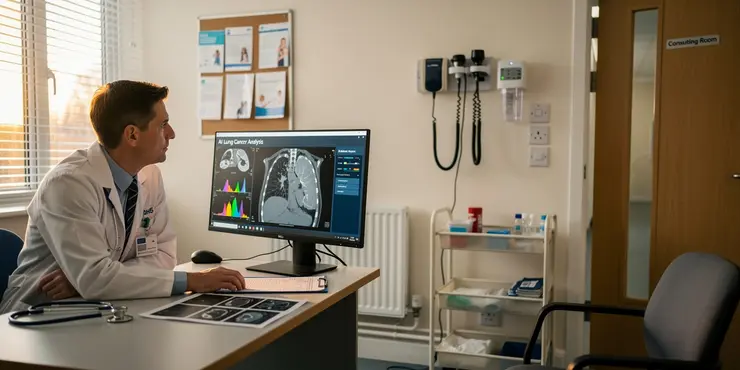
Artificial Intelligence (AI) technologies are revolutionising medical diagnostics. In the UK, AI is increasingly used in detecting lung cancer. These technologies promise improved accuracy and faster results.
Despite their potential benefits, ethical considerations arise when implementing AI. It is crucial to evaluate these factors to ensure AI's responsible use in healthcare.
Accuracy and Reliability
AI systems must be accurate to provide reliable lung cancer detection. Errors in diagnosis could lead to harmful consequences for patients. Ensuring systems are thoroughly validated is essential.
There is a risk if AI models are trained on biased or incomplete datasets. Such biases could lead to disparities in diagnosis across different demographic groups.
Data Privacy and Consent
AI systems require large datasets to function effectively. These datasets often contain sensitive patient information. Safeguarding patient data and maintaining privacy are ethical priorities.
Patients should be informed about how their data is used. Obtaining explicit consent before data collection is crucial to uphold patient rights.
Impact on Medical Professionals
The introduction of AI in diagnostics raises concerns about the role of medical professionals. AI could potentially reduce the need for human intervention in some cases. This may lead to job displacement or changes in the medical workforce.
However, AI can also serve as a tool to assist clinicians. It can aid in decision-making and improve the overall quality of care.
Equity in Healthcare Access
AI technologies should be accessible to all segments of the population. There is a risk of technology being concentrated in well-funded areas. This may widen existing healthcare disparities.
Ensuring equitable access to AI-driven diagnostics is necessary. Policies should aim to distribute technology benefits evenly across communities.
Conclusion
AI has great potential in improving lung cancer detection. However, ethical considerations must not be overlooked in its implementation.
Addressing these concerns will ensure AI contributes positively to patient care. Thoughtful regulation and oversight can help maximise benefits and minimise risks.
Frequently Asked Questions
What are the ethical considerations of using AI in lung cancer detection?
The ethical considerations include patient privacy, data security, potential biases in AI models, and the need for informed consent.
How does patient privacy factor into the use of AI for lung cancer detection?
Patient data used to train AI models must be properly anonymized and protected to prevent unauthorized access and breaches.
Are there biases in AI models for lung cancer detection, and how do they pose ethical challenges?
Yes, AI models can inherit biases present in training data, potentially leading to unequal treatment across different populations.
What role does informed consent play in using AI for lung cancer detection?
Patients should be informed about how AI will be used in their care and the potential risks and benefits, allowing them to make informed decisions.
How can data security be ensured when using AI for lung cancer detection?
Implementing strong encryption, access controls, and regular security audits can help protect patient data.
Can the use of AI in lung cancer detection lead to over-reliance on technology?
There is a risk that clinicians may rely too heavily on AI recommendations, which may affect their ability to make independent conclusions.
What steps can be taken to reduce bias in AI models for lung cancer detection?
Diverse and comprehensive datasets should be used during training, and continuous monitoring and updating of models is necessary.
How does AI impact the doctor-patient relationship in lung cancer detection?
AI can supplement doctors' expertise but it can also create challenges in communication if patients are worried about the impersonal nature of technology.
Is there an ethical obligation to disclose AI involvement in lung cancer diagnosis to patients?
Yes, patients have the right to know when AI is being used in their diagnosis and how it may impact their care.
How do costs and access play into the ethical considerations of AI in lung cancer detection?
AI technology may be costly and not equally accessible to all patients, raising concerns about fairness and equity in healthcare.
What ethical issues arise from AI making errors in lung cancer detection?
Errors can lead to misdiagnosis or delayed treatment, raising questions about accountability and rectification measures.
Are there guidelines for the ethical use of AI in lung cancer detection?
Many organizations and governments are working to establish guidelines to ensure AI is used responsibly and ethically in healthcare.
How does transparency affect the ethical use of AI in lung cancer detection?
Transparency in how AI systems are developed and used can build trust and allow for better oversight and understanding of AI's role in diagnosis.
Can AI in lung cancer detection reinforce existing health disparities?
If not carefully implemented, AI can potentially worsen health disparities by not being available to underrepresented or disadvantaged groups.
Should AI systems in lung cancer detection be explainable?
Yes, explainability is important for clinicians to understand AI recommendations and for patients to trust in AI-influenced decisions.
What are the ethical implications of AI autonomy in lung cancer detection?
Giving AI systems too much autonomy can be risky as it might lead to decisions without sufficient human oversight or understanding.
How can ethical use of AI in lung cancer detection improve patient outcomes?
By ensuring fair, unbiased, and secure AI applications, patient outcomes can be improved through earlier and more accurate detection of cancer.
What role do regulatory bodies play in the ethical use of AI for lung cancer detection?
Regulatory bodies can enforce standards and guidelines to ensure that AI applications are used responsibly and ethically.
Should there be ethical training for developers of AI systems used in lung cancer detection?
Yes, training developers in ethics can help them build systems that align with patient rights and healthcare standards.
How might ethical issues impact the future development of AI in lung cancer detection?
Addressing ethical issues is crucial for gaining public trust and advancing the technology responsibly, which is essential for its future development.
Useful Links
This website offers general information and is not a substitute for professional advice.
Always seek guidance from qualified professionals.
If you have any medical concerns or need urgent help, contact a healthcare professional or emergency services immediately.
- Ergsy carfully checks the information in the videos we provide here.
- Videos shown by Youtube after a video has completed, have NOT been reviewed by ERGSY.
- To view, click the arrow in centre of video.
- Most of the videos you find here will have subtitles and/or closed captions available.
- You may need to turn these on, and choose your preferred language.
- Go to the video you'd like to watch.
- If closed captions (CC) are available, settings will be visible on the bottom right of the video player.
- To turn on Captions, click settings .
- To turn off Captions, click settings again.
More Items From Ergsy search
-
Are there ethical considerations in using AI for lung cancer detection?
Relevance: 100%
-
How are AI and Robots used to detect lung cancer?
Relevance: 69%
-
What challenges remain in using AI for lung cancer detection?
Relevance: 63%
-
What is the future of AI and robotics in lung cancer detection and treatment?
Relevance: 63%
-
How do AI algorithms detect lung cancer in scans?
Relevance: 61%
-
How does AI impact the cost of lung cancer detection?
Relevance: 61%
-
What role does AI play in lung cancer detection?
Relevance: 60%
-
Which types of imaging data are analyzed by AI for lung cancer detection?
Relevance: 60%
-
Is AI technology in lung cancer detection widely accepted by hospitals?
Relevance: 59%
-
What is the advantage of using AI for lung cancer detection?
Relevance: 59%
-
Have AI systems for lung cancer detection been clinically validated?
Relevance: 56%
-
Can AI help in monitoring lung cancer progression?
Relevance: 52%
-
Can robots perform lung cancer screenings?
Relevance: 51%
-
What is a low-dose CT scan for lung cancer?
Relevance: 51%
-
Are AI systems used alone in lung cancer diagnosis or alongside human radiologists?
Relevance: 51%
-
Can AI systems reduce the rate of false positives in lung cancer screening?
Relevance: 50%
-
Are there any AI-based tools available for lung cancer risk assessment?
Relevance: 49%
-
How can AI improve patient outcomes in lung cancer?
Relevance: 48%
-
Can AI predict lung cancer survival rates?
Relevance: 47%
-
Air Pollution and Lung Cancer
Relevance: 44%
-
Do AI models for lung cancer require a lot of data to train?
Relevance: 43%
-
How do AI-assisted robotic systems enhance lung cancer surgeries?
Relevance: 41%
-
Can a womb lining test detect cancer?
Relevance: 35%
-
Prostate cancer symptoms - detecting them early
Relevance: 35%
-
Can a womb lining test detect cancer?
Relevance: 35%
-
What kinds of cancer screening are available?
Relevance: 31%
-
What is cancer screening?
Relevance: 30%
-
What should I do if I'm considering aspirin for cancer prevention?
Relevance: 29%
-
Bernard's Story - Lung Transplant
Relevance: 28%
-
What dosage of aspirin is considered effective for cancer prevention?
Relevance: 27%
-
Can bowel cancer spread to other parts of the body?
Relevance: 27%
-
How common is bowel cancer?
Relevance: 27%
-
What are the symptoms of testicular cancer?
Relevance: 26%
-
What is Cancer?
Relevance: 26%
-
Is testicular cancer treatable?
Relevance: 26%
-
Is genetic screening available for cancer risk?
Relevance: 25%
-
Vaginal Cancer
Relevance: 25%
-
What are the stages of testicular cancer?
Relevance: 25%
-
What is Bowel Cancer?
Relevance: 25%
-
Ovarian Cancer
Relevance: 25%


