
Find Help
More Items From Ergsy search
-
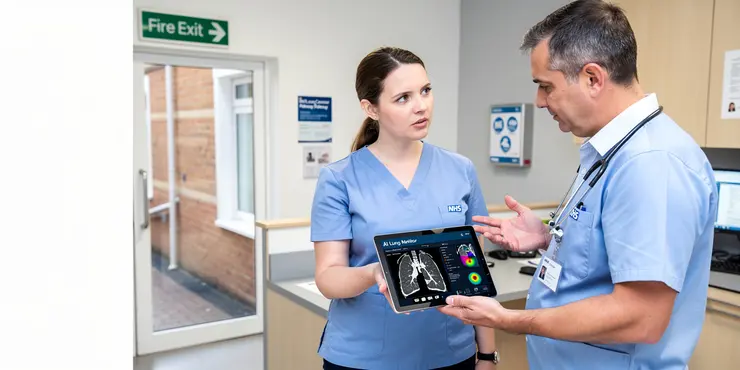
Can AI help in monitoring lung cancer progression?
Relevance: 100%
-
How can AI improve patient outcomes in lung cancer?
Relevance: 58%
-
Air Pollution and Lung Cancer
Relevance: 57%
-
How are AI and Robots used to detect lung cancer?
Relevance: 56%
-
What is the advantage of using AI for lung cancer detection?
Relevance: 55%
-
What is the future of AI and robotics in lung cancer detection and treatment?
Relevance: 53%
-
What is a low-dose CT scan for lung cancer?
Relevance: 53%
-
Can robots perform lung cancer screenings?
Relevance: 52%
-
Do AI models for lung cancer require a lot of data to train?
Relevance: 51%
-
Which types of imaging data are analyzed by AI for lung cancer detection?
Relevance: 51%
-
Have AI systems for lung cancer detection been clinically validated?
Relevance: 51%
-
How do AI algorithms detect lung cancer in scans?
Relevance: 51%
-
Is AI technology in lung cancer detection widely accepted by hospitals?
Relevance: 50%
-
What role does AI play in lung cancer detection?
Relevance: 49%
-
Are there any AI-based tools available for lung cancer risk assessment?
Relevance: 48%
-
What challenges remain in using AI for lung cancer detection?
Relevance: 48%
-
How does AI impact the cost of lung cancer detection?
Relevance: 48%
-
Are AI systems used alone in lung cancer diagnosis or alongside human radiologists?
Relevance: 47%
-
Can AI systems reduce the rate of false positives in lung cancer screening?
Relevance: 47%
-
Are there ethical considerations in using AI for lung cancer detection?
Relevance: 46%
-
Can AI predict lung cancer survival rates?
Relevance: 46%
-
How do AI-assisted robotic systems enhance lung cancer surgeries?
Relevance: 46%
-
How does exercise impact bowel cancer progression?
Relevance: 44%
-
Can exercise help slow down the progression of bowel cancer?
Relevance: 42%
-
Can exercise help slow down the progression of bowel cancer?
Relevance: 42%
-
Can eating vegetables help slow the progression of prostate cancer?
Relevance: 42%
-
Bernard's Story - Lung Transplant
Relevance: 38%
-
What are the stages of testicular cancer?
Relevance: 36%
-
Can testicular cancer spread to other parts of the body?
Relevance: 33%
-
Can bowel cancer spread to other parts of the body?
Relevance: 32%
-
What kinds of cancer screening are available?
Relevance: 32%
-
How can I track my walking progress?
Relevance: 32%
-
How is progress measured for SEND children?
Relevance: 31%
-
What is active surveillance in prostate cancer treatment?
Relevance: 31%
-
How is the stage of bowel cancer determined?
Relevance: 31%
-
Vaginal Cancer
Relevance: 30%
-
Treating prostate cancer
Relevance: 29%
-
What role do tumor markers play in testicular cancer?
Relevance: 29%
-
What is credit monitoring?
Relevance: 29%
-
Can Abiraterone be used for early-stage prostate cancer?
Relevance: 29%
Introduction to Lung Cancer Monitoring
Lung cancer is a leading cause of cancer-related deaths globally, including in the UK. Detecting and monitoring its progression is crucial for effective treatment. Traditional methods rely on imaging and regular check-ups, which can be time-consuming.
Artificial intelligence (AI) offers new possibilities in this area. With AI, doctors can potentially track the disease more efficiently and with greater precision.
The Role of AI in Medical Imaging
AI can analyse medical images, such as CT and MRI scans, with remarkable accuracy. These algorithms can identify patterns and subtle changes in lung tissues over time. This capability allows for earlier detection of progression or response to treatment.
By automating the analysis process, AI reduces the workload on radiologists. This ensures that clinicians can focus on patient care and decision-making.
Benefits of AI in Patient Monitoring
AI systems can continuously monitor patient data. They can alert healthcare providers to any critical changes in the patient's condition. This proactive approach can lead to timely interventions, possibly improving outcomes.
Moreover, AI can integrate various data sources, including patient history and genetic information. It provides a comprehensive view of each patient's unique case, allowing for more personalized care.
AI and Patient Outcomes
Early studies suggest that AI can improve patient outcomes in lung cancer care. By detecting changes earlier, treatment can be adjusted in a timely manner to address the current state of the disease.
However, AI is not without limitations. Successful integration requires high-quality data and robust algorithms. Rigorous validation is essential to ensure reliability and safety in clinical settings.
Challenges and Ethical Considerations
Implementing AI in healthcare introduces several challenges. These include data privacy concerns and the need for regulatory approval. Ensuring that patient data is secure and used ethically is paramount.
Another challenge is ensuring the technology is accessible across different healthcare settings. There is a need for investment and training to fully utilise AI's potential in the NHS.
Conclusion
AI has the potential to revolutionise lung cancer monitoring. It offers the possibility of more precise and timely interventions. Yet, full adoption in the UK healthcare system will require careful planning and investment.
Continued research and collaboration between technologists and healthcare providers are essential. This can ensure that AI's benefits are delivered to all patients safely and effectively.
Frequently Asked Questions
Can AI help in monitoring lung cancer progression?
Yes, AI can be used to monitor lung cancer progression by analyzing medical imaging and patient data to detect changes over time.
How does AI analyze medical images for lung cancer?
AI analyzes medical images, such as CT scans, using advanced algorithms and deep learning techniques to identify tumors, their size, and any changes in their characteristics over time.
What types of AI models are used for lung cancer monitoring?
Deep learning models, particularly convolutional neural networks (CNNs), are commonly used for analyzing medical images related to lung cancer.
Can AI detect small changes in lung tumors?
Yes, AI can detect small changes in lung tumors by comparing images over time and identifying subtle differences that may indicate progression or regression.
Is AI reliable for monitoring lung cancer progression?
AI has shown high accuracy in analyzing medical images, but it should be used in conjunction with expert medical evaluation for the most reliable results.
How does AI improve the accuracy of lung cancer progression monitoring?
AI improves accuracy by providing consistent, objective analysis of medical images, reducing the potential for human error in interpretation.
Can AI predict the progression of lung cancer?
AI can help predict the progression of lung cancer by analyzing patterns in imaging and clinical data, potentially identifying likely outcomes and suggesting tailored treatment options.
What data is needed for AI to monitor lung cancer?
AI requires high-quality medical images such as CT or MRI scans, along with patient history and other clinical data to effectively monitor lung cancer.
How does AI assist doctors in lung cancer monitoring?
AI assists doctors by providing detailed analysis of imaging data, highlighting areas of concern, and offering insights into tumor growth or shrinkage.
Does AI replace the need for regular medical check-ups for lung cancer?
No, AI does not replace regular check-ups but acts as a supplementary tool to provide additional insights for healthcare professionals.
Can AI reduce the time needed for lung cancer monitoring?
AI can potentially reduce the time required for monitoring by quickly processing and analyzing large volumes of imaging data.
What role does machine learning play in lung cancer monitoring?
Machine learning techniques are used to train AI models on large datasets, allowing them to recognize patterns and make accurate predictions regarding lung cancer.
Are there any limitations to using AI in lung cancer monitoring?
Limitations include the quality and availability of data, the need for model validation, and ensuring AI outputs are interpreted correctly by clinicians.
How can AI assist in personalized treatment plans for lung cancer?
AI can analyze data to identify which treatments might be most effective based on similar cases, aiding in the development of personalized treatment plans.
Can AI help in early detection of lung cancer progression?
Yes, AI can help detect early signs of progression by identifying changes in imaging data that may not be immediately noticeable to human reviewers.
What advancements are being made in AI for lung cancer monitoring?
Advancements include improved algorithms for image analysis, integration of multi-modal data, and enhanced prediction models for patient outcomes.
How does AI integrate with existing healthcare systems for lung cancer monitoring?
AI integrates with healthcare systems through software platforms that connect seamlessly with imaging equipment and electronic health records.
What are the potential cost benefits of using AI for lung cancer monitoring?
AI may reduce costs by providing efficient analysis, reducing the need for repeat imaging, and enabling quicker decision-making in treatment planning.
Is AI being used in clinical trials for lung cancer monitoring?
Yes, AI is increasingly being used in clinical trials to assess its efficacy and accuracy in monitoring lung cancer and improving treatment outcomes.
How can patients benefit from AI-driven lung cancer monitoring?
Patients can benefit from more accurate, efficient diagnosis and monitoring, potentially leading to earlier intervention and better management of the disease.
Useful Links
This website offers general information and is not a substitute for professional advice.
Always seek guidance from qualified professionals.
If you have any medical concerns or need urgent help, contact a healthcare professional or emergency services immediately.
- Ergsy carfully checks the information in the videos we provide here.
- Videos shown by Youtube after a video has completed, have NOT been reviewed by ERGSY.
- To view, click the arrow in centre of video.
- Most of the videos you find here will have subtitles and/or closed captions available.
- You may need to turn these on, and choose your preferred language.
- Go to the video you'd like to watch.
- If closed captions (CC) are available, settings will be visible on the bottom right of the video player.
- To turn on Captions, click settings .
- To turn off Captions, click settings again.
More Items From Ergsy search
-
Can AI help in monitoring lung cancer progression?
Relevance: 100%
-
How can AI improve patient outcomes in lung cancer?
Relevance: 58%
-
Air Pollution and Lung Cancer
Relevance: 57%
-
How are AI and Robots used to detect lung cancer?
Relevance: 56%
-
What is the advantage of using AI for lung cancer detection?
Relevance: 55%
-
What is the future of AI and robotics in lung cancer detection and treatment?
Relevance: 53%
-
What is a low-dose CT scan for lung cancer?
Relevance: 53%
-
Can robots perform lung cancer screenings?
Relevance: 52%
-
Do AI models for lung cancer require a lot of data to train?
Relevance: 51%
-
Which types of imaging data are analyzed by AI for lung cancer detection?
Relevance: 51%
-
Have AI systems for lung cancer detection been clinically validated?
Relevance: 51%
-
How do AI algorithms detect lung cancer in scans?
Relevance: 51%
-
Is AI technology in lung cancer detection widely accepted by hospitals?
Relevance: 50%
-
What role does AI play in lung cancer detection?
Relevance: 49%
-
Are there any AI-based tools available for lung cancer risk assessment?
Relevance: 48%
-
What challenges remain in using AI for lung cancer detection?
Relevance: 48%
-
How does AI impact the cost of lung cancer detection?
Relevance: 48%
-
Are AI systems used alone in lung cancer diagnosis or alongside human radiologists?
Relevance: 47%
-
Can AI systems reduce the rate of false positives in lung cancer screening?
Relevance: 47%
-
Are there ethical considerations in using AI for lung cancer detection?
Relevance: 46%
-
Can AI predict lung cancer survival rates?
Relevance: 46%
-
How do AI-assisted robotic systems enhance lung cancer surgeries?
Relevance: 46%
-
How does exercise impact bowel cancer progression?
Relevance: 44%
-
Can exercise help slow down the progression of bowel cancer?
Relevance: 42%
-
Can exercise help slow down the progression of bowel cancer?
Relevance: 42%
-
Can eating vegetables help slow the progression of prostate cancer?
Relevance: 42%
-
Bernard's Story - Lung Transplant
Relevance: 38%
-
What are the stages of testicular cancer?
Relevance: 36%
-
Can testicular cancer spread to other parts of the body?
Relevance: 33%
-
Can bowel cancer spread to other parts of the body?
Relevance: 32%
-
What kinds of cancer screening are available?
Relevance: 32%
-
How can I track my walking progress?
Relevance: 32%
-
How is progress measured for SEND children?
Relevance: 31%
-
What is active surveillance in prostate cancer treatment?
Relevance: 31%
-
How is the stage of bowel cancer determined?
Relevance: 31%
-
Vaginal Cancer
Relevance: 30%
-
Treating prostate cancer
Relevance: 29%
-
What role do tumor markers play in testicular cancer?
Relevance: 29%
-
What is credit monitoring?
Relevance: 29%
-
Can Abiraterone be used for early-stage prostate cancer?
Relevance: 29%


