
Find Help
More Items From Ergsy search
-
Can AI systems reduce the rate of false positives in lung cancer screening?
Relevance: 100%
-
Can robots perform lung cancer screenings?
Relevance: 55%
-
Have AI systems for lung cancer detection been clinically validated?
Relevance: 51%
-
How are AI and Robots used to detect lung cancer?
Relevance: 48%
-
What challenges remain in using AI for lung cancer detection?
Relevance: 48%
-
What is cancer screening?
Relevance: 48%
-
Which types of imaging data are analyzed by AI for lung cancer detection?
Relevance: 48%
-
What is a low-dose CT scan for lung cancer?
Relevance: 48%
-
Are AI systems used alone in lung cancer diagnosis or alongside human radiologists?
Relevance: 47%
-
How do AI-assisted robotic systems enhance lung cancer surgeries?
Relevance: 46%
-
What is the advantage of using AI for lung cancer detection?
Relevance: 46%
-
How does AI impact the cost of lung cancer detection?
Relevance: 45%
-
What can cause a false positive pregnancy test?
Relevance: 45%
-
What role does AI play in lung cancer detection?
Relevance: 45%
-
How do AI algorithms detect lung cancer in scans?
Relevance: 43%
-
Are there any AI-based tools available for lung cancer risk assessment?
Relevance: 42%
-
How can AI improve patient outcomes in lung cancer?
Relevance: 41%
-
NHS breast cancer screening
Relevance: 40%
-
AI Breast Cancer Screening in the UK
Relevance: 40%
-
Is AI technology in lung cancer detection widely accepted by hospitals?
Relevance: 40%
-
What kinds of cancer screening are available?
Relevance: 40%
-
Can lifestyle changes impact the efficacy of cancer screening?
Relevance: 39%
-
Air Pollution and Lung Cancer
Relevance: 39%
-
Can AI help in monitoring lung cancer progression?
Relevance: 38%
-
What happens if my child's screening results are positive?
Relevance: 38%
-
Are there ethical considerations in using AI for lung cancer detection?
Relevance: 38%
-
Are there risks associated with home colorectal cancer tests?
Relevance: 37%
-
What is the future of AI and robotics in lung cancer detection and treatment?
Relevance: 37%
-
What are the recommendations for colorectal cancer screening?
Relevance: 37%
-
Do AI models for lung cancer require a lot of data to train?
Relevance: 36%
-
How does increased screening impact bowel cancer statistics?
Relevance: 35%
-
Are there any risk factors that increase the need for cancer screening?
Relevance: 35%
-
Can AI predict lung cancer survival rates?
Relevance: 34%
-
Is genetic screening available for cancer risk?
Relevance: 34%
-
When should cervical cancer screening begin?
Relevance: 33%
-
What is a skin cancer screening?
Relevance: 33%
-
Bowel cancer screening: Alan Titchmarsh and Tommy Walsh | NHS
Relevance: 33%
-
How often should I get screened for breast cancer?
Relevance: 32%
-
How to do the FIT bowel cancer screening test | Cancer Research UK
Relevance: 32%
-
NHSGGC - Cervical Cancer Screening - English
Relevance: 31%
Introduction to AI in Lung Cancer Screening
Lung cancer screening is crucial for early detection and treatment. However, such screenings often result in false positives. These false positives can lead to unnecessary anxiety and further invasive tests.
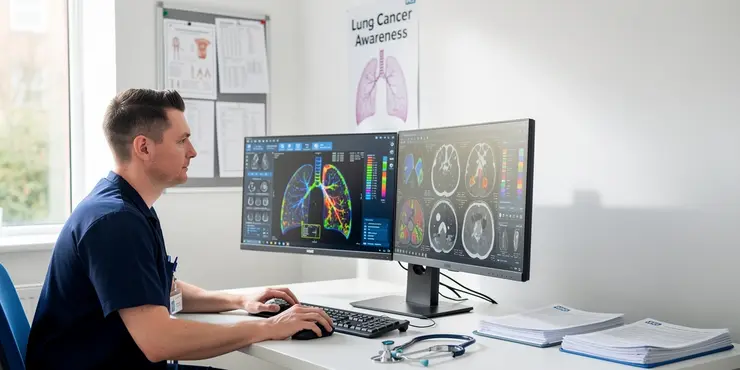
Artificial intelligence (AI) systems are being explored as potential tools to improve the accuracy of lung cancer screening. This may help reduce the number of false positives.
How AI Systems Work in Screening
AI systems use advanced algorithms to analyse medical images. They can detect patterns and abnormalities that might be challenging for human radiologists to spot.
Machine learning, a subset of AI, allows systems to improve over time by learning from vast datasets. This enhances their ability to distinguish between benign and malignant nodules.
Benefits of Using AI for Reducing False Positives
AI systems can potentially increase the precision of lung cancer screening. By improving accuracy, they help in reducing the incidence of false positives.
Reduced false positives mean fewer unnecessary procedures and less stress for patients. This can lead to better use of healthcare resources and increased patient trust in screening programmes.
Challenges Faced by AI in Lung Cancer Screening
Although AI shows promise, it is not flawless. There are challenges in integrating AI into existing healthcare systems.
Concerns about the reliability and ethical implications of AI decisions must be addressed. Proper validation and regulation are essential for gaining trust in AI-assisted screening.
Current Research and Case Studies
Research in AI for lung cancer screening is ongoing. Several studies highlight AI's capability to reduce false positives effectively.
Case studies in healthcare facilities globally provide valuable insights. These studies help refine AI models and address practical challenges in implementation.
The Future of AI in Lung Cancer Screening
AI's role in healthcare is expected to grow, with potential ongoing advancements in technology. With continued research, AI systems could become a standard tool in screening processes.
Collaboration between tech companies, medical professionals, and regulators will be key. Together, they can ensure AI systems contribute positively to lung cancer screening and patient outcomes.
Conclusion
AI systems offer a promising approach to reducing false positives in lung cancer screening. While challenges remain, their potential benefits cannot be overlooked.
With the right development and oversight, AI could transform the screening process, leading to better, more accurate healthcare outcomes for patients in the UK.
Frequently Asked Questions
What is a false positive in lung cancer screening?
A false positive in lung cancer screening occurs when a test incorrectly indicates the presence of lung cancer, causing unnecessary stress and further investigations for the patient.
How can AI systems help reduce false positives in lung cancer screening?
AI systems can analyze imaging data more accurately by identifying patterns and features indicative of cancerous growths, reducing the probability of false positives.
What types of AI are used in lung cancer screening?
Machine learning algorithms and deep learning models, particularly convolutional neural networks (CNNs), are commonly used in analyzing chest CT scans for lung cancer screening.
Are AI systems more accurate than human radiologists in detecting lung cancer?
AI systems can complement human radiologists by identifying subtle patterns in imaging data, but they are most effective when used in conjunction with human expertise.
Do AI systems completely eliminate false positives?
AI systems significantly reduce, but do not completely eliminate, the occurrence of false positives by improving accuracy in image analysis.
What data do AI systems use to improve diagnosis?
AI systems use large datasets of annotated medical images to learn and identify distinguishing features of lung cancer.
Is the use of AI in lung cancer screening approved by regulatory bodies?
Yes, many AI-based tools for lung cancer screening have been approved by regulatory bodies like the FDA, after rigorous testing and validation.
How does AI handle ambiguous or unclear imaging results?
AI systems use probabilistic models to assess the likelihood of cancer presence, providing a confidence score to assist radiologists in decision-making.
What is the role of human expertise in AI-assisted lung cancer screening?
Human radiologists review AI-generated results to confirm diagnoses, providing a critical layer of oversight and expertise.
Can AI systems detect lung cancer at earlier stages than traditional methods?
AI can potentially detect early-stage lung cancer by identifying subtle changes in imaging data that may not be obvious to the human eye.
What are the limitations of AI in lung cancer screening?
AI systems require large, high-quality datasets for training, and their accuracy can be affected by input data quality and variability in imaging protocols.
How do AI systems integrate with existing hospital systems?
AI systems are integrated into hospital radiology workflows via software that analyzes imaging data and provides results alongside traditional methods.
Are there cost benefits to using AI in lung cancer screening?
AI can potentially reduce healthcare costs by decreasing unnecessary procedures and improving screening efficiency, though initial investments in AI technology may be high.
What is the impact of AI on patient experience in lung cancer screening?
Patients may benefit from quicker, more accurate results and less anxiety from false positives, leading to a better overall screening experience.
How do AI systems learn to improve lung cancer screening?
AI systems learn through training on vast datasets of labeled images, continuously improving by iteratively adjusting their algorithms to better detect cancer.
What is the accuracy rate comparison between AI systems and human radiologists?
Studies have shown that AI systems can achieve accuracy comparable to or even exceeding that of human radiologists, particularly in screen-reading tasks.
Do patients need to consent to AI analysis in lung cancer screening?
Patients are typically informed when AI tools are used in their diagnostic process, and consent protocols vary by institution and region.
What measures are in place to ensure the ethical use of AI in lung cancer screening?
Ethical use of AI involves strict data privacy measures, bias mitigation efforts, and transparency in how AI analyses are conducted and used.
How quickly can AI systems provide results in lung cancer screening?
AI systems can process imaging data rapidly, often providing results much quicker than traditional methods while maintaining high accuracy.
What is the future outlook for AI usage in lung cancer screening?
The use of AI in lung cancer screening is expected to grow, with ongoing advancements in technology improving accuracy and reducing costs, ultimately enhancing early detection and patient outcomes.
Useful Links
This website offers general information and is not a substitute for professional advice.
Always seek guidance from qualified professionals.
If you have any medical concerns or need urgent help, contact a healthcare professional or emergency services immediately.
- Ergsy carfully checks the information in the videos we provide here.
- Videos shown by Youtube after a video has completed, have NOT been reviewed by ERGSY.
- To view, click the arrow in centre of video.
- Most of the videos you find here will have subtitles and/or closed captions available.
- You may need to turn these on, and choose your preferred language.
- Go to the video you'd like to watch.
- If closed captions (CC) are available, settings will be visible on the bottom right of the video player.
- To turn on Captions, click settings .
- To turn off Captions, click settings again.
More Items From Ergsy search
-
Can AI systems reduce the rate of false positives in lung cancer screening?
Relevance: 100%
-
Can robots perform lung cancer screenings?
Relevance: 55%
-
Have AI systems for lung cancer detection been clinically validated?
Relevance: 51%
-
How are AI and Robots used to detect lung cancer?
Relevance: 48%
-
What challenges remain in using AI for lung cancer detection?
Relevance: 48%
-
What is cancer screening?
Relevance: 48%
-
Which types of imaging data are analyzed by AI for lung cancer detection?
Relevance: 48%
-
What is a low-dose CT scan for lung cancer?
Relevance: 48%
-
Are AI systems used alone in lung cancer diagnosis or alongside human radiologists?
Relevance: 47%
-
How do AI-assisted robotic systems enhance lung cancer surgeries?
Relevance: 46%
-
What is the advantage of using AI for lung cancer detection?
Relevance: 46%
-
How does AI impact the cost of lung cancer detection?
Relevance: 45%
-
What can cause a false positive pregnancy test?
Relevance: 45%
-
What role does AI play in lung cancer detection?
Relevance: 45%
-
How do AI algorithms detect lung cancer in scans?
Relevance: 43%
-
Are there any AI-based tools available for lung cancer risk assessment?
Relevance: 42%
-
How can AI improve patient outcomes in lung cancer?
Relevance: 41%
-
NHS breast cancer screening
Relevance: 40%
-
AI Breast Cancer Screening in the UK
Relevance: 40%
-
Is AI technology in lung cancer detection widely accepted by hospitals?
Relevance: 40%
-
What kinds of cancer screening are available?
Relevance: 40%
-
Can lifestyle changes impact the efficacy of cancer screening?
Relevance: 39%
-
Air Pollution and Lung Cancer
Relevance: 39%
-
Can AI help in monitoring lung cancer progression?
Relevance: 38%
-
What happens if my child's screening results are positive?
Relevance: 38%
-
Are there ethical considerations in using AI for lung cancer detection?
Relevance: 38%
-
Are there risks associated with home colorectal cancer tests?
Relevance: 37%
-
What is the future of AI and robotics in lung cancer detection and treatment?
Relevance: 37%
-
What are the recommendations for colorectal cancer screening?
Relevance: 37%
-
Do AI models for lung cancer require a lot of data to train?
Relevance: 36%
-
How does increased screening impact bowel cancer statistics?
Relevance: 35%
-
Are there any risk factors that increase the need for cancer screening?
Relevance: 35%
-
Can AI predict lung cancer survival rates?
Relevance: 34%
-
Is genetic screening available for cancer risk?
Relevance: 34%
-
When should cervical cancer screening begin?
Relevance: 33%
-
What is a skin cancer screening?
Relevance: 33%
-
Bowel cancer screening: Alan Titchmarsh and Tommy Walsh | NHS
Relevance: 33%
-
How often should I get screened for breast cancer?
Relevance: 32%
-
How to do the FIT bowel cancer screening test | Cancer Research UK
Relevance: 32%
-
NHSGGC - Cervical Cancer Screening - English
Relevance: 31%


