
Speak To An Expert
Get clear, personalised advice for your situation.
Jot down a few questions to make the most of your conversation.
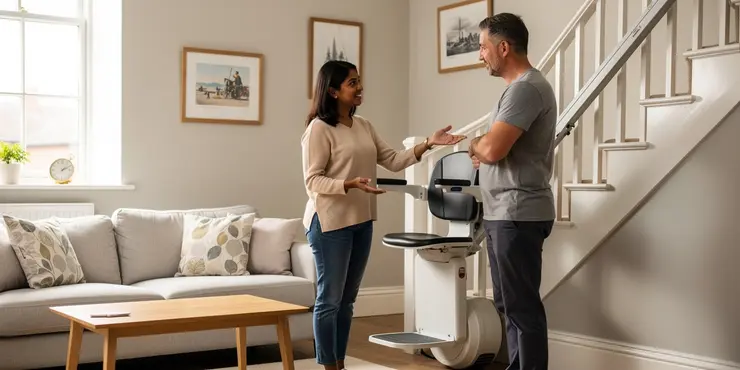
Can stair lifts be customised?
Yes, stair lifts can often be tailored to suit different users and homes. In the UK, suppliers usually offer a range of options designed to improve comfort, safety, and ease of use. The right setup depends on the staircase shape, the user’s mobility needs, and the available space.
Customisation is especially useful in properties where access is limited or the user has specific physical requirements. A good stair lift should feel practical and straightforward, not complicated. That is why many models can be adjusted before installation.
Adjusting for the staircase
One of the main ways stair lifts are customised is by fitting the rail to the staircase. Straight staircases normally need a standard rail, while curved or split stairs require a made-to-measure solution. This helps the lift run smoothly and safely along the exact route needed.
Installers can also consider tight landings, doorways, and the position of the stairs in the home. In many cases, the rail can be designed to sit neatly out of the way when not in use. This is particularly helpful in smaller UK homes where space matters.
Features for user comfort
Many stair lifts come with adjustable seats, armrests, and footrests to make the ride more comfortable. Swivel seats can make it easier to get on and off at the top of the stairs. Some models also offer padded seating for users who need extra support.
Controls can often be positioned to suit the user’s strength and reach. For example, left- or right-handed controls may be available, and some lifts include simple buttons or joystick-style operation. These details can make daily use much easier for people with arthritis or reduced dexterity.
Safety and accessibility options
Safety features can also be adapted to the user’s needs. Many stair lifts include seat belts, obstruction sensors, and smooth start-stop technology to reduce sudden movement. These features are useful for people who may feel unsteady or anxious when using the lift.
For users with more complex needs, a perch seat or standing platform may be more suitable than a standard chair. Some stair lifts can also support heavier weights or include powered folding parts to reduce bending. This makes them more accessible for a wider range of users.
Getting the right advice
The best way to find a suitable stair lift is through a home assessment. A professional installer can measure the staircase and discuss how the lift will be used day to day. This helps ensure the final solution matches both the home and the individual.
In the UK, it is worth asking about aftercare, servicing, and warranty options too. A customised stair lift should not only fit well at installation, but also remain reliable over time. With the right advice, many people can find a model that meets their needs very closely.
Frequently Asked Questions
Stair lift customization is the process of tailoring a stair lift to fit a specific staircase, user needs, and home layout. It can improve accessibility by making the lift more comfortable, safer, and easier to use, while also helping it blend better with the stairway and surrounding decor.
Common stair lift customization options include seat size, seat height, swivel seat settings, armrest style, footrest design, rail length, control placement, safety sensors, upholstery color, and folding mechanisms. These features can be adjusted to better match mobility needs and personal preferences.
Stair lift customization can help narrow staircases by using compact seat designs, slim rails, fold-up armrests, and foldable footrests. These adjustments reduce the amount of space the lift occupies when not in use and help preserve safe passage on the stairs.
Yes, stair lift customization is often essential for curved staircases. A custom curved rail can be measured and manufactured to follow the exact shape of the stairs, allowing the lift to travel smoothly around turns, landings, and bends.
Stair lift customization can adjust seat height, seat width, armrest spacing, and footrest position to fit different body sizes and heights. This helps improve posture, comfort, and safe transfer on and off the lift.
Stair lift customization can include seat belts, obstacle sensors, swivel seat locks, secure mounting hardware, battery backup, and call/send controls. These options help reduce risks and make the lift safer for everyday use.
Stair lift customization can add powered swivel seats, easy-to-press controls, automatic folding components, and ergonomic seating to reduce physical effort. These features make it easier for users with limited strength, joint pain, or balance issues to use the lift independently.
Yes, stair lift customization often includes choices for upholstery, rail finish, seat color, and trim details. These options can help the lift blend with the home's interior style rather than standing out visually.
Stair lift customization for outdoor use usually includes weather-resistant materials, protective covers, corrosion-resistant parts, and sealed electronics. Indoor customization focuses more on fit, comfort, and appearance, while outdoor versions prioritize durability and weather protection.
Stair lift customization can account for whether the staircase is oriented to the left or right by adjusting rail placement, seat orientation, and swivel direction. This ensures the lift matches the stair layout and provides safe mounting and dismounting.
Stair lift customization can include rail extensions, track parking positions, and hinge rails to avoid blocking doorways or landings. These modifications help maintain access to nearby areas while keeping the lift functional and safe.
Stair lift customization is a key part of installation planning because the staircase must be measured carefully and the lift components selected to fit the exact space. Proper planning helps avoid obstructions, improves safety, and ensures the lift operates smoothly.
Yes, stair lift customization can improve comfort with padded seats, lumbar support, adjustable armrests, wider footrests, and smoother ride settings. These features can make longer or steeper trips feel more secure and less tiring.
Stair lift customization can include remote controls, key switches, folding components, and easy-access charging points that make the lift simpler for caregivers to manage. It can also reduce the physical strain involved in helping someone move between floors.
For a user with arthritis, stair lift customization should focus on large easy-grip controls, low-force switches, padded seating, smooth swivel action, and minimal need for twisting or lifting. These changes can reduce joint stress and make the lift easier to use.
Stair lift customization can affect maintenance by changing the complexity of the system and the types of parts used. Choosing durable materials, reliable controls, and appropriate safety features can help support long-term performance and reduce service needs.
Yes, stair lift customization can include battery backup systems, charging rails, and power-efficient components. Battery backup helps the lift continue operating during outages and improves reliability in everyday use.
Stair lift customization is different because it tailors the lift to the staircase and the user, while a standard model follows a more fixed design. Customization is often necessary for unusual stair shapes, special comfort needs, or specific space limitations.
Important measurements for stair lift customization include stair width, stair angle, total rise, landing space, turn locations, door clearance, and available wall space. Accurate measurements help ensure the lift fits safely and functions correctly.
Stair lift customization can benefit older adults, people with disabilities, individuals recovering from surgery, and anyone who has difficulty climbing stairs safely. In a multi-story home, customization helps the lift better match the user's mobility needs and the home's layout.

Ergsy Search Results
This website offers general information and is not a substitute for professional advice.
Always seek guidance from qualified professionals.
If you have any medical concerns or need urgent help, contact a healthcare professional or emergency services immediately.
Some of this content was generated with AI assistance. We've done our best to keep it accurate, helpful, and human-friendly.
- Ergsy carefully checks the information in the videos we provide here.
- Videos shown by Youtube after a video has completed, have NOT been reviewed by ERGSY.
- To view, click the arrow in centre of video.
- Most of the videos you find here will have subtitles and/or closed captions available.
- You may need to turn these on, and choose your preferred language.
- Go to the video you'd like to watch.
- If closed captions (CC) are available, settings will be visible on the bottom right of the video player.
- To turn on Captions, click settings.
- To turn off Captions, click settings again.