
Speak To An Expert
Get clear, personalised advice for your situation.
Jot down a few questions to make the most of your conversation.
What the diagnosis process involves
Dementia is diagnosed by looking at a person’s symptoms, medical history, and how their thinking and memory are affected. There is no single test that can confirm dementia straight away.
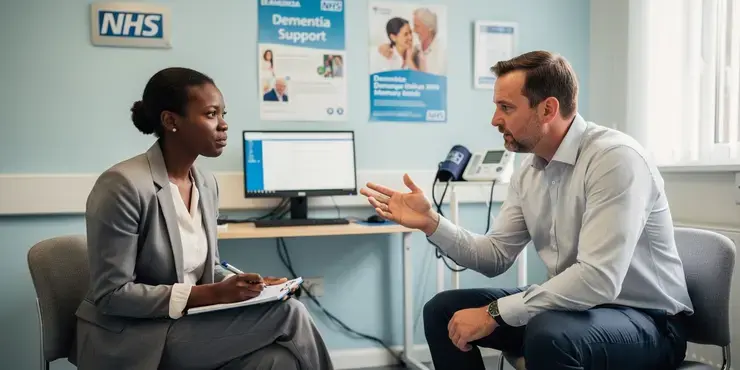
A GP is usually the first point of contact in the UK. They will ask about changes noticed by the person and, with consent, by a family member or carer.
The aim is to find out whether the symptoms are caused by dementia, another health problem, or a combination of factors.
First appointment with the GP
The GP will often ask about memory problems, confusion, mood changes, and difficulties with daily tasks. They may also ask when the symptoms started and whether they are getting worse.
A brief memory or thinking test may be carried out. This can check things like recall, attention, language, and orientation to time and place.
The GP may also review medicines, alcohol use, sleep, and general health. These factors can sometimes affect memory and thinking.
Tests and checks
Blood tests are often arranged to look for treatable causes of similar symptoms. These may include thyroid problems, vitamin deficiencies, infections, or other medical conditions.
A urine test may also be done if infection is suspected. In some cases, a hearing or sight check can help rule out problems that may look like memory loss.
Brain scans, such as a CT scan or MRI scan, may be used. These can help identify strokes, tumours, bleeding, or patterns of brain shrinkage linked to certain types of dementia.
Referral to a specialist
If dementia is still suspected, the GP will usually refer the person to a specialist. This may be a memory clinic, old age psychiatrist, neurologist, or another dementia service.
The specialist will do a fuller assessment. This may include more detailed memory tests, questions about day-to-day abilities, and a review of mood and behaviour.
In many cases, a diagnosis is made after several appointments rather than one visit. This allows the team to build a clearer picture over time.
Getting the diagnosis
If dementia is diagnosed, the doctor should explain the type of dementia and what it means. Common types include Alzheimer’s disease, vascular dementia, and dementia with Lewy bodies.
The person and their family should be given time to ask questions. They should also receive information about support services, treatment options, and planning ahead.
Getting a diagnosis can be difficult, but it can also help people understand what is happening and access the right care and support sooner.
Frequently Asked Questions
Dementia diagnosis is the medical process of determining whether a person has dementia, what type it may be, and whether another condition could be causing the symptoms.
Early signs that may lead to dementia diagnosis include memory loss, difficulty finding words, confusion about time or place, trouble with planning, and changes in mood or judgment.
A dementia diagnosis can be performed by a primary care doctor, neurologist, geriatrician, psychiatrist, or other qualified clinician with experience in cognitive disorders.
Dementia diagnosis is made through a combination of medical history, cognitive testing, physical and neurological exams, laboratory tests, brain imaging, and information from family or caregivers.
Tests used in dementia diagnosis may include memory and thinking assessments, blood tests, urine tests, brain scans such as MRI or CT, and sometimes more specialized neurological testing.
Dementia diagnosis can take one visit or several appointments over weeks or months, depending on the complexity of symptoms and the tests needed to rule out other causes.
No, dementia diagnosis usually cannot be confirmed with a single test because clinicians need to evaluate symptoms, function, test results, and possible alternative explanations.
Conditions that can mimic dementia diagnosis symptoms include depression, medication side effects, vitamin deficiencies, thyroid problems, sleep disorders, infections, and delirium.
Dementia diagnosis identifies a syndrome involving cognitive decline, while Alzheimer’s diagnosis identifies a specific cause of that decline. Alzheimer’s disease is one type of dementia.
Yes, a dementia diagnosis can be wrong if symptoms are caused by another condition, if testing is incomplete, or if the type of dementia is difficult to distinguish from another disorder.
Someone should seek dementia diagnosis when memory or thinking problems begin to affect daily life, safety, work, finances, or relationships, or when symptoms are worsening over time.
For a dementia diagnosis appointment, it helps to bring a list of symptoms, medications, past medical history, notes from family members, and examples of changes in daily functioning.
Family history can influence dementia diagnosis by increasing suspicion for inherited risk, but it does not by itself confirm dementia or determine the exact cause.
Yes, dementia diagnosis can sometimes be made in the early stages when symptoms are subtle, especially if cognitive testing and clinical history show clear decline from prior functioning.
Caregivers often provide valuable details for dementia diagnosis by describing changes in memory, behavior, language, safety, and the ability to manage daily tasks.
Some parts of dementia diagnosis can be done through telehealth, such as history-taking and certain cognitive assessments, but in-person exams, labs, or imaging are often still needed.
After dementia diagnosis is confirmed, the care team usually discusses the type of dementia, treatment options, safety planning, support services, and follow-up monitoring.
No, dementia diagnosis can differ by type because Alzheimer’s disease, vascular dementia, Lewy body dementia, and frontotemporal dementia may have different patterns and test findings.
Yes, medications can affect dementia diagnosis results because some drugs may cause confusion, sedation, or memory problems that look like cognitive decline.
Dementia diagnosis is often reasonably accurate when performed by experienced clinicians using multiple sources of information, but early or unusual cases can still be challenging.

Ergsy Search Results
This website offers general information and is not a substitute for professional advice.
Always seek guidance from qualified professionals.
If you have any medical concerns or need urgent help, contact a healthcare professional or emergency services immediately.
Some of this content was generated with AI assistance. We've done our best to keep it accurate, helpful, and human-friendly.
- Ergsy carefully checks the information in the videos we provide here.
- Videos shown by Youtube after a video has completed, have NOT been reviewed by ERGSY.
- To view, click the arrow in centre of video.
- Most of the videos you find here will have subtitles and/or closed captions available.
- You may need to turn these on, and choose your preferred language.
- Go to the video you'd like to watch.
- If closed captions (CC) are available, settings will be visible on the bottom right of the video player.
- To turn on Captions, click settings.
- To turn off Captions, click settings again.