
Get Answers
Introduction to AI in Medical Imaging
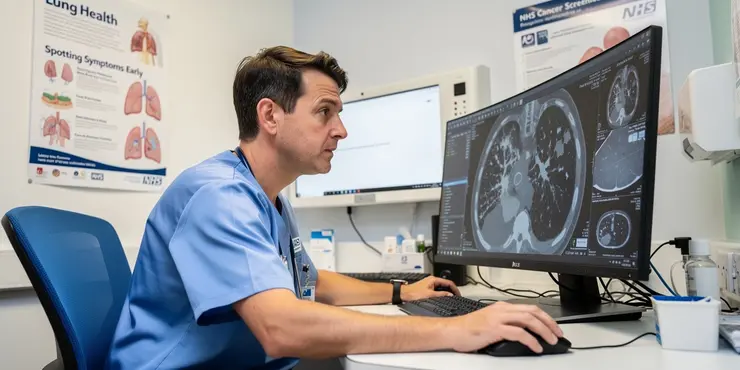
Artificial intelligence (AI) is increasingly being used in medical imaging to help diagnose diseases. Among its applications, AI assists in detecting lung cancer through the analysis of scans.
This enhances the ability of radiologists to identify cancerous lesions more accurately and efficiently. It also aids in early diagnosis, potentially saving lives.
How AI Algorithms Work
AI algorithms are trained using a vast number of medical images and known outcomes. This training enables them to learn the patterns associated with lung cancer.
During diagnosis, these algorithms analyse CT or MRI scans, identifying abnormalities that may indicate cancer. Their performance is constantly compared with actual diagnoses to improve accuracy.
Benefits of Using AI in Lung Cancer Detection
AI can quickly process large datasets, making it valuable in handling the large volumes of imaging data in lung cancer screenings. This swift analysis can reduce the burden on radiologists.
Moreover, AI often detects subtle changes in imaging that might be missed by the human eye, particularly in the early stages of cancer. This capability significantly improves the chances of early intervention and treatment success.
Challenges and Considerations
While AI provides significant advantages, it also faces challenges. The quality and representativeness of the training data are critical to the algorithm's reliability.
There is also a need to ensure that AI systems are interpretable and transparent. Clear communication between AI developers and healthcare professionals is essential for safe integration into clinical practice.
The Future of AI in Lung Cancer Detection
The role of AI in lung cancer detection is expected to expand. Continuous improvements in algorithm development and data availability will refine accuracy.
As more hospitals and clinics integrate AI tools, collaborative efforts between developers and medical staff will be crucial. This collaboration aims to ensure that AI complements human expertise, enhancing patient outcomes.
Conclusion
AI algorithms play a vital role in advancing lung cancer detection. They provide a powerful tool for early diagnosis, potentially leading to better survival rates.
As the technology evolves, maintaining and improving the collaboration between AI experts and healthcare providers will be key to realising its full potential in the NHS and beyond.
Frequently Asked Questions
AI algorithms typically use CT (Computed Tomography) scans to detect lung cancer because they provide detailed images of the lungs and chest.
AI algorithms analyze CT scans by using deep learning models, especially convolutional neural networks (CNNs), to recognize patterns and anomalies indicative of lung cancer.
Machine learning helps AI algorithms learn from large datasets of labeled CT scans, allowing them to improve their accuracy in detecting lung cancer over time.
AI algorithms can achieve a level of accuracy comparable to or sometimes exceeding that of radiologists, particularly in identifying certain patterns, though they are typically used to assist rather than replace humans.
AI algorithms differentiate by analyzing the shape, size, texture, and growth patterns of nodules, using a trained model to assess the likelihood of malignancy.
Yes, AI algorithms require labeled datasets with confirmed diagnoses to train effectively in recognizing cancerous patterns.
Data augmentation artificially increases the diversity of training data by applying transformations to existing images, aiding the model in learning more robust patterns.
While AI algorithms primarily focus on detecting nodules and potential malignancies, some advanced models can also provide insights into the stage of lung cancer, although clinical decisions require comprehensive evaluation by medical professionals.
AI can miss subtle nuances that human radiologists might catch, may produce false positives or negatives, and often requires large, diverse datasets for accurate training.
Performance is typically evaluated using metrics such as accuracy, sensitivity, specificity, and area under the ROC curve (AUC) on validation datasets.
Radiologists work alongside AI to validate and interpret AI findings, ensuring that the insights provided by the algorithms are incorporated into a comprehensive clinical assessment.
CNNs in AI extract hierarchical features from input scans through convolutional layers, enabling them to detect complex patterns indicative of lung cancer.
Pre-processing may include normalization, resizing, and noise reduction to enhance the quality and consistency of input scans for AI analysis.
AI algorithms are trained on diverse datasets covering a range of scan qualities and anatomical variations to improve robustness and generalizability.
While CT scans are the primary focus, advanced AI models can be adapted to work with other modalities like MRI or PET, though these are less common for lung cancer detection.
Recent advancements include improved model architectures, enhanced training techniques like transfer learning, and integration into clinical workflows for real-time analysis assistance.
AI aids in early detection, reduces diagnostic errors, and streamlines workflow, leading to faster and potentially more effective patient management.
Early detection of lung cancer significantly increases the chances of successful treatment and survival by identifying the disease at a more treatable stage.
AI algorithms leverage parallel computing, efficient data processing techniques, and scalable architectures to handle and analyze large volumes of imaging data efficiently.
Challenges include the need for extensive validation, integration with existing healthcare systems, ensuring data privacy, and gaining clinician trust in AI assessments.

Ergsy Search Results
This website offers general information and is not a substitute for professional advice.
Always seek guidance from qualified professionals.
If you have any medical concerns or need urgent help, contact a healthcare professional or emergency services immediately.
Some of this content was generated with AI assistance. We've done our best to keep it accurate, helpful, and human-friendly.
- Ergsy carefully checks the information in the videos we provide here.
- Videos shown by Youtube after a video has completed, have NOT been reviewed by ERGSY.
- To view, click the arrow in centre of video.
- Most of the videos you find here will have subtitles and/or closed captions available.
- You may need to turn these on, and choose your preferred language.
- Go to the video you'd like to watch.
- If closed captions (CC) are available, settings will be visible on the bottom right of the video player.
- To turn on Captions, click settings.
- To turn off Captions, click settings again.