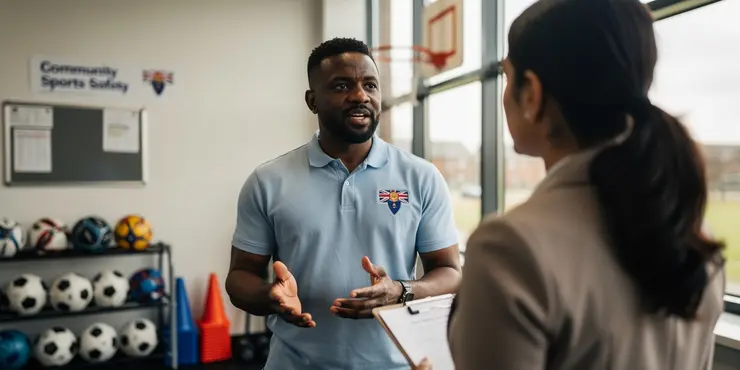

Speak To An Expert
Get clear, personalised advice for your situation.
Jot down a few questions to make the most of your conversation.
General safety duties for community sports groups
Most UK community sports groups must carry out a risk assessment, keep equipment safe, and make sure coaches or volunteers are appropriately trained. They also need clear rules for reporting accidents, checking first aid cover, and supervising participants properly.
The exact requirements depend on the sport, the age of players, and whether the group uses hired facilities or its own premises. Insurance, safeguarding, and emergency planning are common across almost all sports.
Contact sports and higher injury risk activities
Sports such as rugby, boxing, martial arts, and hockey usually need stricter controls because of the higher risk of collision and head injury. Clubs often need stronger safeguarding, concussion procedures, mouthguard guidance, and better pitch or ring inspections.
Coaches may also need sport-specific qualifications and safer practice rules, such as limits on contact in training. For younger players, organisations often require modified rules, age banding, and extra supervision.
Water-based sports
Swimming, rowing, sailing, canoeing, and open-water activities bring extra requirements around drowning risk, weather, and water access. Groups often need written rescue plans, qualified lifeguards or safety boat cover, and checks on tidal or river conditions.
Equipment such as buoyancy aids, helmets, and throwlines may be essential depending on the activity. Leaders also need clear communication systems in case someone is separated from the group or gets into difficulty.
Indoor and facility-based sports
Gymnastics, badminton, indoor football, and dance have different safety issues because of floors, equipment, lighting, and space layout. Clubs need to check mats, goals, nets, and storage areas, and make sure fire exits are kept clear.
Where sports use school halls or leisure centres, the venue operator may handle some duties, but the club still needs to manage its own activity safely. That includes controlling numbers, setting up equipment correctly, and making sure participants wear suitable footwear or protective kit.
Disability, youth, and outdoor sports
Sessions for children or disabled participants often require more detailed supervision, safer ratios, and adapted risk assessments. Leaders may need to think about communication needs, mobility support, medical conditions, and consent from parents or carers.
Outdoor sports such as football, cricket, and athletics also vary by environment. Clubs may need weather plans for heat, cold, lightning, or poor ground conditions, plus additional checks for posts, nets, boundaries, and spectator areas.
Why the requirements vary
In practice, safety compliance is shaped by the main hazards of each sport. The greater the chance of collision, drowning, falling, or equipment-related injury, the more detailed the controls usually need to be.
Community groups should review governing body guidance for their sport, because this often sets the expected standard. A simple approach is not enough if the activity is inherently risky or involves children, novices, or mixed-ability participants.
Frequently Asked Questions
Youth soccer programs should follow sport-specific safety compliance requirements such as age-appropriate equipment, concussion protocols, field inspection, hydration planning, emergency action plans, qualified supervision, and safe contact rules.
Basketball programs should comply with requirements for court safety, footwear and equipment checks, concussion response, heat and hydration planning for outdoor play, crowd control, first aid readiness, and supervision ratios appropriate to participants' ages.
Baseball and softball programs should meet safety requirements for batting helmet use, pitcher protection, field maintenance, dugout safety, lightning and weather procedures, emergency communication, and concussion and injury reporting protocols.
Football programs require strong contact-sport compliance measures, including certified coaching, protective equipment checks, tackling safety rules, concussion management, return-to-play procedures, heat illness prevention, and clear emergency response plans.
Volleyball programs should ensure safe net and pole setup, floor and court inspection, appropriate supervision, first aid access, injury reporting, hydration planning, and age-appropriate training to reduce collision and overuse injuries.
Rugby programs should follow contact-sport safety requirements such as scrum and tackle instruction, protective equipment rules where applicable, concussion protocols, qualified coaching, medical readiness, and safe practice limits by age group.
Hockey programs should comply with requirements for helmet and protective gear use, rink or field inspection, checking and body-contact rules, concussion management, hydration and temperature controls, and emergency action planning.
Gymnastics programs should include equipment inspection, mat safety, spotter training, skill progression controls, injury response procedures, supervision standards, and compliance with facility and apparatus maintenance requirements.
Swimming programs should meet requirements for lifeguard coverage, water quality, drowning prevention, emergency rescue procedures, swimmer-to-supervisor ratios, safe deck conditions, and medical screening for participants when needed.
Martial arts programs should include protective gear rules, controlled sparring standards, instructor qualifications, concussion awareness, mat safety, hygiene procedures, and clearly documented progression and emergency response policies.
Tennis programs should follow requirements for court surface safety, equipment condition, weather monitoring, hydration access, safe ball handling, supervision of minors, and injury reporting and response procedures.
Track and field programs should ensure event-specific safety measures, such as runway and throwing-area controls, warm-up supervision, footwear checks, hydration and heat policies, and safe spacing during practices and meets.
Cycling programs should comply with helmet requirements, route risk assessment, traffic and visibility rules, rider skill screening, mechanical bike checks, supervision standards, and emergency communication procedures.
Rowing programs should address water safety, flotation and boat integrity checks, weather and lightning procedures, capsize response plans, coach and coxswain communication, and participant swimming ability requirements where applicable.
Cheerleading programs should follow requirements for stunt progression, mat use, spotting, qualified coaching, concussion awareness, safe landing practices, and emergency response planning for falls and overuse injuries.
Dance and performance movement programs should include floor safety, injury prevention warm-ups, footwear and attire checks, fatigue management, supervision, and protocols for reporting sprains, strains, and repetitive-use injuries.
Skiing and snowboarding programs should comply with helmet use, slope condition assessment, weather monitoring, lift safety, avalanche or terrain risk controls where relevant, and injury and rescue response procedures.
Lacrosse programs should include protective equipment compliance, stick and contact rule enforcement, field inspection, concussion protocols, hydration planning, and supervision by trained coaches familiar with the sport's risks.
Handball programs should meet safety requirements for court surface inspection, eye and hand protection where required, warm-up and conditioning, contact rule enforcement, first aid readiness, and injury reporting processes.
Multi-sport community recreation programs should apply sport-specific safety compliance requirements for each activity, including equipment checks, supervision, emergency action plans, participant screening, weather policies, and documented incident reporting.

Ergsy Search Results
This website offers general information and is not a substitute for professional advice.
Always seek guidance from qualified professionals.
If you have any medical concerns or need urgent help, contact a healthcare professional or emergency services immediately.
Some of this content was generated with AI assistance. We've done our best to keep it accurate, helpful, and human-friendly.
- Ergsy carefully checks the information in the videos we provide here.
- Videos shown by Youtube after a video has completed, have NOT been reviewed by ERGSY.
- To view, click the arrow in centre of video.
- Most of the videos you find here will have subtitles and/or closed captions available.
- You may need to turn these on, and choose your preferred language.
- Go to the video you'd like to watch.
- If closed captions (CC) are available, settings will be visible on the bottom right of the video player.
- To turn on Captions, click settings.
- To turn off Captions, click settings again.