
Get Answers
When to report scramblers
If off-road bikes or scramblers are being ridden illegally on the same route, it is worth reporting them. Repeated use can suggest a pattern of anti-social behaviour, dangerous riding, or use of public paths where bikes are not allowed.
You should report them if they are causing alarm, speeding near pedestrians, using footpaths, bridleways, parks, estates, or other public spaces where motorbikes should not be. It is especially important to act if riders are threatening people, damaging property, or riding in a way that puts others at risk.
Who to report it to
If the bikes are currently causing danger or are being ridden aggressively, call 999. This is the right option if there is an immediate risk to the public, a collision, or serious criminal damage.
For repeated problems that are not an emergency, report them to your local police force using 101 or the force’s online reporting form. If the issue is persistent, ask to make an anti-social behaviour report so the pattern is logged properly.
You can also report the route and timings to your local council, especially if the bikes are using public parks, paths, or council-owned land. In some areas, community safety teams or anti-social behaviour teams may also investigate recurring problems.
What information to collect
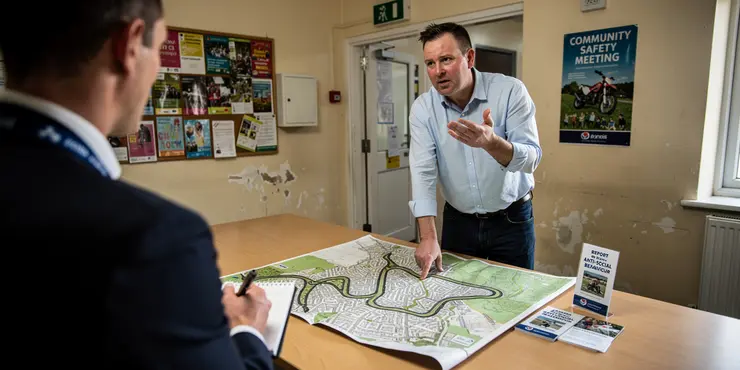
Give as much detail as possible, including the exact route, dates, times, and how often the bikes appear. If there are regular patterns, such as the same time each evening or the same weekend route, make that clear.
Try to note the number of bikes, the colour, make, model, distinctive clothing, and any registration numbers if they have them. If it is safe to do so, take photos or video from a distance, but never put yourself at risk to gather evidence.
How to make your report more effective
Keep a simple log of each incident. A record showing repeated behaviour can help the police or council understand that this is not a one-off problem.
If neighbours are affected too, encourage them to report it separately. Multiple reports from different people can strengthen the case and may help authorities prioritise the issue.
It can also help to mention any impact on the community, such as noise, fear, blocked access, or unsafe conditions for children, cyclists, and pedestrians. The more clearly you explain the harm, the easier it is for officers to assess the problem.
What to expect next
Police may use your report to patrol the area, gather intelligence, or identify the riders. In some cases, they may work with the council or landowners to target a known route or hotspot.
Do not confront the riders yourself. If the problem continues, keep reporting each incident so the authorities have an ongoing picture of what is happening.
Frequently Asked Questions
Illegal off-road bike scramblers repeat route reporting is the process of documenting and submitting repeated sightings of unlawful off-road bike or scrambler activity along the same routes so that enforcement teams can identify patterns, hotspots, and times of concern.
It is important because repeated route reports can help authorities recognize recurring problem areas, improve patrol planning, support evidence gathering, and reduce risks to pedestrians, drivers, landowners, and wildlife.
Residents, landowners, cyclists, walkers, community wardens, and others who repeatedly observe the same unlawful off-road bike or scrambler activity can use illegal off-road bike scramblers repeat route reporting to document those patterns.
A strong report should include the date, time, exact location, direction of travel, route taken, number of riders, bike descriptions, clothing details, audible features such as engine noise, and whether the same route has been used before.
You can submit illegal off-road bike scramblers repeat route reporting through the local police non-emergency channel, a community reporting portal, a council service if available, or any designated neighborhood enforcement system that accepts repeated incident records.
It should be updated every time the same route is used again or whenever a new detail becomes available, because repeated and time-stamped entries are what make illegal off-road bike scramblers repeat route reporting useful.
A useful report is specific, consistent, and factual. It should describe the route clearly enough to be mapped and should avoid guesses, exaggeration, or personal opinions.
Yes. Photos or videos can strengthen illegal off-road bike scramblers repeat route reporting if they are taken safely, legally, and without putting anyone at risk. Clear images of bikes, route markers, or direction of travel are especially helpful.
If a plate is safely visible, it should be included in illegal off-road bike scramblers repeat route reporting. However, many off-road bikes may not display plates clearly, so other identifying details are also important.
By recording the same route, time, and location repeatedly, illegal off-road bike scramblers repeat route reporting helps show whether the activity happens on certain days, during specific hours, or along predictable paths.
Do not approach riders, chase them, block the route, or put yourself in danger. Make notes from a safe distance and report details afterward through the proper channel.
Yes, many reporting systems allow anonymous illegal off-road bike scramblers repeat route reporting. Anonymous reports can still be valuable if they include accurate dates, times, and route details.
One-time reporting captures a single incident, while illegal off-road bike scramblers repeat route reporting captures recurring use of the same route over time, which helps reveal a broader pattern of behavior.
The route should be described with clear landmarks, street names, trail names, access points, direction of travel, and entry and exit locations so responders can map the route accurately.
Yes. Repeated reports can support community meetings, neighborhood watch coordination, signage requests, gating proposals where lawful, and targeted engagement with enforcement agencies.
Avoid rumors, personal disputes, assumptions about identity, and vague statements. The report should focus on observable facts connected to illegal off-road bike scramblers repeat route reporting.
Repeated timestamps help show a schedule or trend, making it easier for enforcement to plan patrols and compare incidents across different days and weeks.
Typically, local police, community safety teams, council officers, or other designated enforcement staff review illegal off-road bike scramblers repeat route reporting, depending on the reporting system used.
Effective reporting can lead to targeted patrols, evidence-based enforcement, warning letters, route monitoring, seizure actions where lawful, and a reduction in repeated illegal off-road bike activity.
Keep a dated log with notes, images, videos, and submission references in a secure place so you can provide consistent follow-up information if asked by enforcement officials.

Ergsy Search Results
This website offers general information and is not a substitute for professional advice.
Always seek guidance from qualified professionals.
If you have any medical concerns or need urgent help, contact a healthcare professional or emergency services immediately.
Some of this content was generated with AI assistance. We've done our best to keep it accurate, helpful, and human-friendly.
- Ergsy carefully checks the information in the videos we provide here.
- Videos shown by Youtube after a video has completed, have NOT been reviewed by ERGSY.
- To view, click the arrow in centre of video.
- Most of the videos you find here will have subtitles and/or closed captions available.
- You may need to turn these on, and choose your preferred language.
- Go to the video you'd like to watch.
- If closed captions (CC) are available, settings will be visible on the bottom right of the video player.
- To turn on Captions, click settings.
- To turn off Captions, click settings again.