
Get Answers
What rebates and tax credits do
Rebates and tax credits reduce the upfront cost of installing a heat pump. That means you pay less on day one, which improves the overall financial case straight away.
A rebate is usually a direct discount or cash-back style payment. A tax credit reduces the amount of tax you owe, although the benefit may arrive later depending on the scheme.
Why they matter for payback time
Heat pump payback time is the period it takes for lower energy bills to offset the installation cost. If grants or tax relief cut the initial spend, the payback period becomes shorter.
For example, a heat pump with a higher purchase price may still pay back faster if a rebate removes several thousand pounds from the bill. The same applies if a tax credit lowers your net cost after purchase.
The UK picture
In the UK, support is often offered through government schemes rather than general tax credits. The Boiler Upgrade Scheme is one of the main incentives for homeowners in England and Wales, and it can make a major difference to payback time.
Because energy prices and installation costs vary, the size of the saving matters. A larger upfront incentive can reduce the number of years needed before running cost savings outweigh the initial outlay.
How the numbers change
Without support, a heat pump may take many years to pay for itself, especially in a home that still needs insulation improvements. With a rebate or tax credit, the starting cost is lower, so the payback calculation improves immediately.
The effect is even stronger when combined with lower running costs. If a household also uses the heat pump efficiently, the reduced energy bills and the incentive together can shorten payback substantially.
What to check before you buy
Not every rebate works in the same way, and some schemes have eligibility rules. You should check whether the property type, installer accreditation, or existing heating system affects what you can claim.
It is also wise to compare the incentive with the total installed cost, not just the headline equipment price. A good quote should show the grant or rebate separately so you can see the real net cost and estimate payback more accurately.
Bottom line
Rebates and tax credits can make heat pumps much easier to justify financially. They reduce the amount you need to recover through energy bill savings, which shortens payback time.
For UK households, the key is to look at the full package: upfront support, installation quality, home insulation, and expected running costs. When all of these line up, a heat pump becomes a more attractive long-term investment.
Frequently Asked Questions
It covers how long a heat pump takes to pay for itself and how rebates and tax credits can reduce the upfront cost and shorten the payback period.
Rebates lower the purchase price immediately, and tax credits reduce your tax bill later, both of which reduce the net cost you need to recover through energy savings.
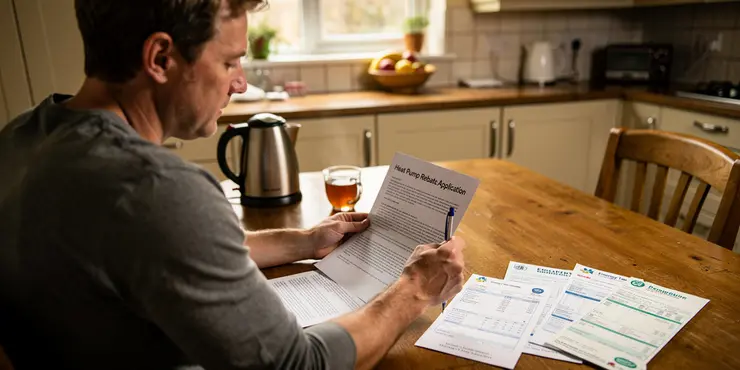
Subtract rebates and tax credits from the installed cost, then compare the remaining cost to your annual energy savings to estimate how many years it takes to break even.
Home size, climate, electricity and fuel prices, equipment efficiency, installation cost, usage patterns, and the size of available rebates and tax credits all affect payback time.
Eligibility usually depends on income, property type, location, utility provider, equipment efficiency ratings, and whether the installer and product meet program requirements.
You typically apply through a utility, state energy office, contractor portal, or tax filing process, and you may need receipts, model numbers, and proof of installation.
Many programs support both air-source and ground-source heat pumps, but the rebate and tax credit amounts, as well as eligibility rules, can differ.
Some rebates and tax credits may cover part of the full installed cost, including labor, while others apply only to equipment, so program rules must be checked carefully.
Often yes, but stacking rules vary. You may be able to combine utility rebates, state incentives, and federal tax credits, subject to program limits.
Heat pumps may have higher upfront costs than furnaces, but rebates, tax credits, and lower operating costs can make the long-term payback more favorable.
The exact form depends on the jurisdiction, but federal incentives commonly use IRS forms related to energy-efficient home improvements, while state programs may have separate paperwork.
Some incentives apply only to existing homes, while others may support new construction or major renovations, depending on the specific program.
Income limits can determine whether you qualify for larger rebates, enhanced credits, or special low-income programs with more generous savings.
Common documents include proof of purchase, installation invoices, equipment specifications, serial or model numbers, manufacturer certificates, and proof of residence.
Rebates usually reduce payback time immediately by lowering upfront cost, while tax credits reduce payback after you file taxes and receive the credit benefit.
Utility programs can significantly reduce upfront cost, especially in areas with aggressive electrification goals, and they may materially shorten the payback period.
Yes, many incentives require minimum efficiency ratings such as SEER2, HSPF2, or COP thresholds, and higher-efficiency models may qualify for larger incentives.
Usually yes, financing does not automatically disqualify you, but the rebate and tax credit rules still depend on the program and how the installation is documented.
They provide a useful estimate, but actual payback can vary because of changing energy prices, installer quotes, incentive availability, and household usage patterns.
You can check federal energy pages, state energy offices, local utility websites, and contractor resources for the latest rules, amounts, and eligibility details.

Ergsy Search Results
This website offers general information and is not a substitute for professional advice.
Always seek guidance from qualified professionals.
If you have any medical concerns or need urgent help, contact a healthcare professional or emergency services immediately.
Some of this content was generated with AI assistance. We've done our best to keep it accurate, helpful, and human-friendly.
- Ergsy carefully checks the information in the videos we provide here.
- Videos shown by Youtube after a video has completed, have NOT been reviewed by ERGSY.
- To view, click the arrow in centre of video.
- Most of the videos you find here will have subtitles and/or closed captions available.
- You may need to turn these on, and choose your preferred language.
- Go to the video you'd like to watch.
- If closed captions (CC) are available, settings will be visible on the bottom right of the video player.
- To turn on Captions, click settings.
- To turn off Captions, click settings again.