
Speak To An Expert
Get clear, personalised advice for your situation.
Jot down a few questions to make the most of your conversation.
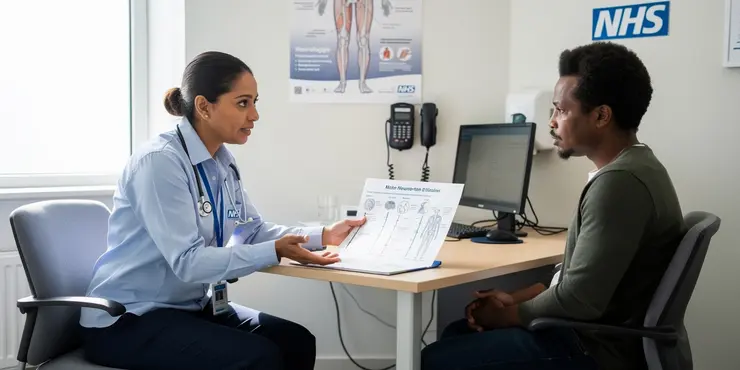
Initial symptoms and GP appointment
MND, or motor neurone disease, is often diagnosed after a person first notices changes such as muscle weakness, cramps, twitching, or problems with speech and swallowing. These symptoms can vary, and they do not always mean someone has MND. However, if they keep getting worse, it is important to speak to a GP.
A GP will usually ask about the symptoms, when they started, and whether they are affecting daily activities. They may also check strength, reflexes, balance, and coordination. Because MND can look similar to other conditions, the GP will usually refer the person to a neurologist for further tests.
Seeing a neurologist
A neurologist is a doctor who specialises in conditions affecting the brain, nerves, and muscles. They will take a detailed medical history and carry out a neurological examination. This helps them look for signs that suggest MND, as well as signs that point to other possible causes.
There is no single test that confirms MND. Instead, diagnosis is based on symptoms, examination findings, and the results of several tests. The neurologist may need to arrange different investigations to rule out conditions such as nerve damage, vitamin deficiency, or other muscle and nerve disorders.
Tests used to help diagnose MND
Common tests may include blood tests, MRI scans, and nerve tests such as an electromyography, or EMG. Blood tests can help check for other causes of weakness or muscle changes. An MRI scan may be used to look for problems in the brain or spinal cord that could explain the symptoms.
An EMG measures the electrical activity in muscles and can show whether nerves are working properly. Some people may also have nerve conduction studies, which check how well signals travel along the nerves. These tests can be uncomfortable, but they are usually brief and very helpful in the diagnostic process.
Getting a diagnosis
It can take time to diagnose MND because doctors need to be sure that other possible conditions have been excluded. In some cases, several appointments and tests are needed before a diagnosis is confirmed. This waiting period can be stressful, especially when symptoms are getting worse.
If MND is diagnosed, the neurologist should explain what type it is, how it may affect the body, and what support is available. They may also refer the person to a specialist MND clinic. These teams often include nurses, physiotherapists, speech and language therapists, and occupational therapists.
After diagnosis
After diagnosis, support usually starts quickly so that symptoms can be managed and planning can begin. People may be offered advice on equipment, mobility, communication, and nutrition. They may also be referred for emotional support for themselves and their family.
If you are worried about symptoms, it is best to see a GP as soon as possible. Early assessment does not always mean MND, but it can help identify the cause and make sure the right support is in place. Getting help early can make a real difference.
Frequently Asked Questions
MND diagnosis is the clinical process of confirming motor neurone disease by reviewing symptoms, neurological examination findings, medical history, and test results to rule out other conditions with similar signs.
Early signs that may lead to MND diagnosis include muscle weakness, twitching, cramps, stiffness, clumsiness, slurred speech, difficulty swallowing, and changes in walking or hand function.
MND diagnosis is usually made by a neurologist, often with experience in motor neurone disease, sometimes supported by specialists in respiratory, speech, or rehabilitation medicine.
Tests used in MND diagnosis may include blood tests, nerve conduction studies, electromyography, MRI scans, lung function tests, and sometimes genetic testing, depending on the symptoms and suspected subtype.
MND diagnosis can take weeks to months, because doctors often need repeated assessments and multiple tests to exclude other conditions before confirming the diagnosis.
MND diagnosis can be difficult because its symptoms may resemble other neurological, muscle, or spinal disorders, and there is no single definitive routine test that confirms all cases.
No, MND diagnosis is usually not confirmed with a single test. It is generally based on a combination of clinical examination, symptom pattern, and investigations that support the diagnosis and exclude alternatives.
During MND diagnosis, doctors commonly rule out conditions such as cervical spine disease, multiple sclerosis, peripheral neuropathy, myasthenia gravis, muscle disorders, vitamin deficiencies, and certain infections or inflammatory diseases.
Electromyography can support MND diagnosis by detecting abnormal electrical activity in muscles, which may indicate nerve damage affecting motor neurons.
MRI is used in MND diagnosis mainly to look for other causes of weakness or speech problems, such as structural problems in the brain, brainstem, or spinal cord, rather than to confirm MND directly.
A neurological examination is very important in MND diagnosis because it helps identify patterns of upper and lower motor neuron involvement, weakness, reflex changes, muscle wasting, and signs that point toward MND.
Yes, MND diagnosis can sometimes be considered even when symptoms are mild, but doctors may monitor the person over time if the signs are not yet clear enough for a confident diagnosis.
No, genetic testing is not always part of MND diagnosis. It may be recommended in some cases, especially if there is a family history of MND or an early-onset presentation.
At an MND diagnosis appointment, you can expect a detailed discussion of symptoms, medical history, a neurological examination, possible referral for tests, and explanation of what the findings may mean.
Yes, MND diagnosis can sometimes be mistaken for another disease early on because several conditions can cause weakness, speech changes, or muscle wasting, which is why careful evaluation is essential.
Family history can influence MND diagnosis by increasing suspicion of a genetic form of the disease and prompting doctors to consider inherited causes and genetic counselling.
After MND diagnosis is confirmed, doctors usually discuss the diagnosis clearly, arrange specialist multidisciplinary care, manage symptoms, and plan ongoing support for mobility, communication, breathing, and nutrition.
Yes, a second opinion can help with MND diagnosis if the symptoms are unclear, if test results are uncertain, or if you want confirmation from another neurologist experienced in motor neurone disease.
MND diagnosis affects treatment planning by guiding symptom management, rehabilitation, communication support, nutritional care, respiratory monitoring, and planning for future needs and supports.
After MND diagnosis, support can come from neurologists, specialist nurses, therapists, respiratory teams, speech and language therapists, dietitians, social workers, and MND support organizations.

Ergsy Search Results
This website offers general information and is not a substitute for professional advice.
Always seek guidance from qualified professionals.
If you have any medical concerns or need urgent help, contact a healthcare professional or emergency services immediately.
Some of this content was generated with AI assistance. We've done our best to keep it accurate, helpful, and human-friendly.
- Ergsy carefully checks the information in the videos we provide here.
- Videos shown by Youtube after a video has completed, have NOT been reviewed by ERGSY.
- To view, click the arrow in centre of video.
- Most of the videos you find here will have subtitles and/or closed captions available.
- You may need to turn these on, and choose your preferred language.
- Go to the video you'd like to watch.
- If closed captions (CC) are available, settings will be visible on the bottom right of the video player.
- To turn on Captions, click settings.
- To turn off Captions, click settings again.