
Speak To An Expert
Get clear, personalised advice for your situation.
Jot down a few questions to make the most of your conversation.
Understanding Your Rights and Responsibilities
In the UK, the use of security cameras for private protection is quite common, but it comes with certain legal stipulations. Homeowners are typically within their rights to install security cameras on their property. However, these rights come with responsibilities, particularly in respecting the privacy of neighbors. If a neighbor's security camera covers parts of your property where you expect privacy, it may raise legal and ethical concerns.
Legality of Blocking a Security Camera
Inquiring whether you can legally block a neighbor's security camera requires an understanding of property rights and privacy laws in the UK. Here’s the key point: directly obstructing a camera could potentially lead to claims of interference with property or legal disputes. Instead, consider indirect methods that ensure both your privacy and adhere to the law. Intentionally causing damage to your neighbor's security equipment would clearly be illegal under UK law.
Privacy and Data Protection Considerations
The UK's Data Protection Act and the General Data Protection Regulation (GDPR) offer some privacy protections. If a camera captures images beyond the owner's property, it could infringe upon your privacy rights. In this case, the camera owner could be required to comply with data protection laws, such as minimizing capture of areas where privacy is expected, like gardens or windows.
Approaching the Issue Amicably
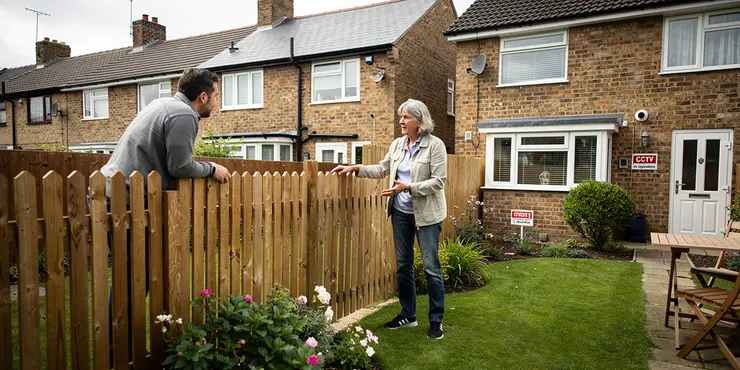
The best course of action is to discuss the issue with your neighbor directly. They may not realize that their camera infringes on your privacy. Open, friendly communication can often resolve the issue without legal intervention. Suggest reasonable adjustments to the camera's angle or positioning to respect privacy. Sometimes, privacy screens or arranged plantings can shield your view without altering the camera's functionality.
Mediation and Legal Advice
If discussions with your neighbor do not lead to a satisfactory resolution, consider mediation services. Mediation is a cost-effective and less confrontational solution than pursuing legal action. However, if you believe your privacy rights are being significantly violated, legal advice might be necessary. Solicitors specializing in property or privacy law can provide guidance on potential actions and implications.
Summary
Blocking a neighbor's security camera is a delicate matter governed by a mix of property and privacy law in the UK. It is not outright illegal, but direct interference can lead to disputes. Always start with dialogue and attempt to resolve any issues amicably. Privacy protection laws may offer recourse if a neighbor's camera is intrusive. Ultimately, understanding and negotiation are key in handling such matters effectively.
Understanding Your Rights and Responsibilities
In the UK, lots of people use security cameras to protect their homes. You can put cameras on your house. But you must think about your neighbors' privacy. If a neighbor's camera points at places where you want privacy, like your garden, it can be a problem.
Legality of Blocking a Security Camera
You might wonder if you can block a neighbor's security camera. This is about property rights and privacy rules in the UK. Be careful: blocking a camera might cause problems or arguments. A better idea is to look for ways to protect your privacy that do not break the rules. Do not damage your neighbor's camera. That is not allowed by law.
Privacy and Data Protection Considerations
The UK has laws that protect your privacy, like the Data Protection Act and the GDPR. If a camera records outside the owner's land, it might affect your privacy rights. The camera owner should follow these laws and not record private areas, like your garden or windows, without reason.
Approaching the Issue Amicably
The best thing to do is talk to your neighbor. They might not know their camera is a problem. A friendly chat can help sort things out without using the law. You could suggest changing where the camera points. Sometimes, plants or screens can help keep your space private.
Mediation and Legal Advice
If talking does not work, you can try mediation. Mediation helps solve problems without going to court and costs less. If your privacy is affected a lot, you might need legal help. A lawyer who knows about property or privacy can tell you what to do next.
Summary
Blocking a neighbor's camera is tricky because of UK laws about property and privacy. It is not always against the rules, but blocking it might cause trouble. Start by talking and try to solve it nicely. Privacy laws can help if a camera is too intrusive. Understanding and discussion are the best ways to fix these issues.
Frequently Asked Questions
It can be legal to block the view with your property, like installing a fence or planting trees, but be cautious and check local laws and neighborhood agreements.
Consider property boundaries, local laws, community guidelines, and discuss with your neighbor to find an amicable solution first.
Yes, as long as the trees are within your property lines and comply with local regulations.
Yes, tampering with a neighbor's security camera, such as physically blocking the lens, is likely illegal.
Install privacy screens, adjust window treatments, or use strategic landscaping to enhance privacy without litigation.
Discuss your concerns with your neighbor first. If unresolved, consult local laws or seek legal advice.
Laws vary, but generally cameras should not be directed at another's private space like windows or backyards without consent.
It depends on your jurisdiction, so it's best to check local regulations or consult with a legal professional.
Yes, often misunderstandings can be resolved through open communication, leading to an agreeable solution.
Yes, within height regulations and property lines, a high fence can legally block a camera's view.
Illegally blocking a camera could lead to civil lawsuits or criminal charges, so always verify legality first.
Yes, typically cameras can record public spaces as there is no expectation of privacy in public areas.
Recording audio often requires consent due to wiretapping laws, which vary by location, so verify local regulations.
Consult local zoning or HOA rules and possibly seek guidance from a legal expert before making modifications.
Potentially, if not done considerately or within legal bounds, which is why communication is encouraged.
HOAs may have specific rules regarding cameras and property modifications, so consult them for guidance.
Yes, there are privacy films and apps that alert you to camera lenses, but their legality varies.
Potentially, but ensure it doesn’t become a nuisance or violate light pollution ordinances.
Yes, mediation can offer a neutral ground to discuss concerns and find mutually acceptable solutions.
Yes, keep detailed records of conversations and agreements for future reference if legal resolution becomes necessary.
You can put up a fence or plant trees on your property. This might block someone's view, and it's usually okay. But first, check the rules in your area and talk to your neighbors to make sure it's alright.
If you need help understanding this, ask a friend, family member, or local community service for advice. You can also use online tools that help read or explain things in a simple way.
Think about where the land borders are, check the local rules, and look at community advice. Talk to your neighbor to try and find a friendly solution first.
Yes, you can as long as the trees are on your land and follow the local rules.
Messing with a neighbor's security camera, like covering it, is probably against the law.
Put up special screens on windows, change curtains or blinds, or plant trees and bushes to keep your space private without needing to go to court.
Talk to your neighbor about the problem. If it is still not fixed, look at local rules or ask a lawyer for help.
Rules can be different in each place. But usually, you should not point a camera at someone else's private area like their windows or backyards unless they say it's okay.
It can be different in each place. It's a good idea to check the rules where you live or talk to a lawyer for help.
Yes, talking honestly can help fix problems. This way, people can find a way to agree.
Yes, you can put up a tall fence to block a camera if it follows the height rules and is on your property.
If you try to stop a camera from filming in a wrong way, you might get in trouble. So, check if it is okay to do this before you try.
Yes, cameras can usually film in public places because people don't expect privacy there.
Before you record someone talking, you need to ask them if it’s okay. Each place has different rules about recording, so check the rules where you are first.
Check the rules for your neighborhood or community group. You might need to talk to a lawyer before you make any changes.
It's important to talk to each other. This helps to make sure everyone is happy and following the rules.
Check with your local Homeowners Association (HOA) before putting up cameras or changing your home. They have rules you need to follow.
Yes, there are special screens and apps that can help you find cameras. The rules about using them can be different depending on where you are.
Maybe. But make sure it's not too bright and doesn't break any rules about light in your area.
Yes, mediation can help. It gives everyone a fair place to talk about problems and find solutions that work for everyone.
Yes, it's a good idea to write down what people say and any deals you make. This can help if you need to solve problems with the law later.

Ergsy Search Results
This website offers general information and is not a substitute for professional advice.
Always seek guidance from qualified professionals.
If you have any medical concerns or need urgent help, contact a healthcare professional or emergency services immediately.
Some of this content was generated with AI assistance. We've done our best to keep it accurate, helpful, and human-friendly.
- Ergsy carefully checks the information in the videos we provide here.
- Videos shown by Youtube after a video has completed, have NOT been reviewed by ERGSY.
- To view, click the arrow in centre of video.
- Most of the videos you find here will have subtitles and/or closed captions available.
- You may need to turn these on, and choose your preferred language.
- Go to the video you'd like to watch.
- If closed captions (CC) are available, settings will be visible on the bottom right of the video player.
- To turn on Captions, click settings.
- To turn off Captions, click settings again.