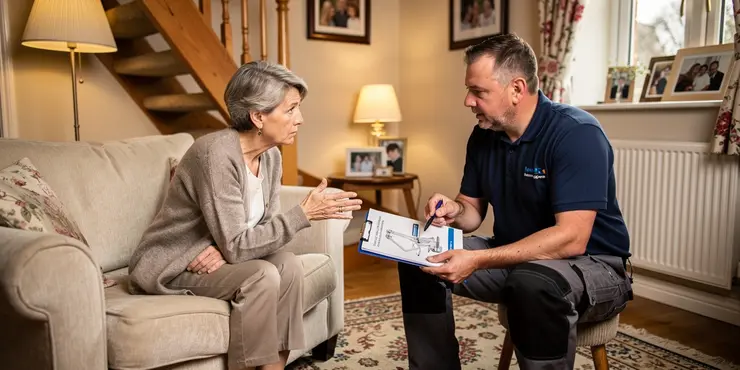

Speak To An Expert
Get clear, personalised advice for your situation.
Jot down a few questions to make the most of your conversation.
Is professional installation required for stair lifts?
In most cases, yes. A stair lift should be professionally installed to ensure it is safe, secure, and properly fitted to your staircase. This is especially important in the UK, where homes can vary widely in layout, width, and stair design.
Although some people may be tempted by DIY options, stair lifts are specialist mobility products. They need accurate measurements, electrical checks, and careful fitting to work correctly. Professional installation helps reduce the risk of faults, instability, or unnecessary wear.
Why professional fitting matters
A stair lift must be aligned precisely with the shape of the stairs. Even small mistakes during installation can affect smooth travel and safety. A trained installer will check the staircase, the wall or banister structure, and the user’s needs before fitting begins.
Professional installers also make sure the lift meets the manufacturer’s specifications. This can be important for keeping the warranty valid. It also gives peace of mind that the lift has been installed by someone with the right experience.
Can you install a stair lift yourself?
Some stair lifts are marketed as straightforward to fit, but self-installation is usually not recommended. Unless you have specialist knowledge and the right tools, it can be difficult to get the rail position, power supply, and safety features correct. Stair lifts are not like flat-pack furniture; they are medical mobility devices with safety implications.
DIY installation may also create problems with insurance or future servicing. If anything goes wrong, a poorly fitted stair lift could become unsafe or expensive to repair. For most households, professional fitting is the most sensible option.
What does installation involve?
Installation usually starts with a home assessment and measurement of the staircase. The installer will check whether the lift is suitable for a straight, curved, or narrow stairway. They may also discuss options such as foldable seats, powered swivels, or remote controls.
On installation day, the rail and chair unit are fixed securely to the stairs, not the wall in most cases. The lift is then tested thoroughly to make sure it stops correctly, runs smoothly, and is easy to use. The installer should also show the user how to operate it safely.
Are there any exceptions?
In very rare cases, someone with technical expertise may be able to assist with parts of the process, but final fitting should still be checked by a professional. Some suppliers offer self-installation on certain models, but this is not common in the UK. Even then, many customers choose professional setup for safety and convenience.
If you are considering a stair lift, it is best to ask the supplier whether installation is included. In most situations, professional installation is strongly recommended and often expected. It is the safest way to make sure the lift works properly from day one.
Frequently Asked Questions
Yes, professional installation is generally required to ensure safety and proper functioning of stair lifts.
Most manufacturers strongly recommend professional installation due to the technical expertise needed.
Professional installation ensures that the stair lift is securely mounted, correctly aligned, and adheres to safety standards.
Some models claim to be DIY-friendly, but professional installation is still recommended for optimal performance and safety.
Incorrect installation can lead to malfunctions, safety hazards, and void warranties.
Many stair lifts plug into standard outlets, but professionals ensure proper wiring and safe power supply.
Installation usually takes between 2 to 4 hours, depending on the complexity of the staircase.
Yes, most warranties require professional installation to remain valid.
Yes, professional installers receive specialized training on various stair lift models.
Many suppliers include installation in the price, but some may charge it separately.
Professional installers assess your staircase to determine the best fit and address any installation challenges.
Professional installation is designed to minimize damage, typically only requiring a few brackets attached to the stairs.
Permits are rarely required for residential installations, but professional installers will know local regulations.
Most retailers recommend certified installers or have their own professional teams.
Proper professional installation makes future maintenance easier and more predictable.
Yes, they can safely remove and dispose of or relocate existing stair lifts.
Costs vary depending on location and stair configuration, but typically range from $500 to $2,000.
Professional installers are knowledgeable about any applicable building codes in your region.
Yes, installers usually provide a full demonstration and user training after installation.
Installers provide documentation that can be essential for warranty support and service claims.

Ergsy Search Results
This website offers general information and is not a substitute for professional advice.
Always seek guidance from qualified professionals.
If you have any medical concerns or need urgent help, contact a healthcare professional or emergency services immediately.
Some of this content was generated with AI assistance. We've done our best to keep it accurate, helpful, and human-friendly.
- Ergsy carefully checks the information in the videos we provide here.
- Videos shown by Youtube after a video has completed, have NOT been reviewed by ERGSY.
- To view, click the arrow in centre of video.
- Most of the videos you find here will have subtitles and/or closed captions available.
- You may need to turn these on, and choose your preferred language.
- Go to the video you'd like to watch.
- If closed captions (CC) are available, settings will be visible on the bottom right of the video player.
- To turn on Captions, click settings.
- To turn off Captions, click settings again.