
Get Answers
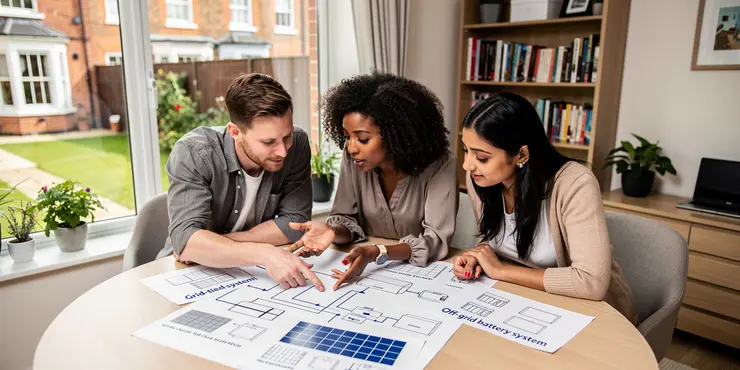
What is a grid-tied battery system?
A grid-tied battery system is connected to the UK electricity grid as well as your solar panels. It lets you store excess solar power during the day and use it later in the evening or when demand is higher.
If your battery runs low, you can still draw electricity from the grid. This makes it a flexible option for most homes, especially where a reliable mains connection already exists.
What is an off-grid battery system?
An off-grid battery system is designed to work without any connection to the national grid. It relies entirely on solar panels, batteries, and usually a backup generator to supply power.
This setup is more common in remote locations, such as rural properties, cabins, or sites where grid connection is unavailable or too expensive. It must be carefully sized to cover your household’s energy needs all year round.
Main differences between the two
The biggest difference is whether you are connected to the grid. A grid-tied system gives you backup power from the mains, while an off-grid system must provide all electricity independently.
Grid-tied systems are usually simpler and cheaper to install. Off-grid systems often need larger batteries, more solar panels, and extra equipment to make sure power is available even in winter or during long periods of poor weather.
Another key difference is reliability. In the UK, off-grid homes need to manage seasonal changes carefully because solar generation is lower in winter. A grid-connected home can lean on the grid when solar output drops.
Which option suits a UK home?
For most UK households, a grid-tied battery is the practical choice. It supports lower electricity bills, improves solar self-consumption, and provides reassurance if your panels do not produce enough power.
Off-grid systems are best for properties without a feasible grid connection or for people who want full energy independence. However, they usually require a bigger upfront investment and more active energy management.
How to choose the right system
Think about your location, energy use, and budget. If you already have a grid connection, a grid-tied battery is often the most cost-effective and convenient option.
If you are building in a remote area or want to live completely off the mains, an off-grid system may be suitable. It is wise to get advice from a qualified solar installer who understands UK conditions and planning requirements.
Frequently Asked Questions
Grid-tied systems connect to the utility grid and usually use batteries only as backup or for time-shifting, while off-grid systems operate independently and rely on batteries as the primary source of stored power. The best choice depends on whether you want utility support, full energy independence, or a combination of both.
Grid-tied systems without battery backup typically shut down during outages for safety, but a grid-tied battery system can keep essential loads running. Off-grid systems are designed for outage-free operation because they are not dependent on the utility grid at all.
Grid-tied installations usually need solar panels, an inverter, a utility interconnection setup, and optionally batteries and a battery inverter. Off-grid installations also need solar panels, batteries, charge controllers, inverters, and often a generator or other backup source for low-sun periods.
Grid-tied systems are often less expensive upfront because they can use the utility grid as backup storage. Off-grid systems usually cost more because they require larger battery banks, more robust equipment, and additional design work to cover all energy needs without grid support.
Off-grid battery solar installation is usually better for remote properties where utility service is unavailable or too expensive to extend. Grid-tied systems are generally preferable when utility access exists and you want lower battery requirements and simpler energy management.
Batteries allow grid-tied systems to store excess solar power for evening use or outages, improving resilience and self-consumption. In off-grid systems, batteries are essential because they store the energy needed to power the home when solar production is low or unavailable.
Grid-tied installations typically require utility interconnection approval, electrical permits, and sometimes inspection before activation. Off-grid installations still usually need building and electrical permits, but they generally do not require utility interconnection approval.
Grid-tied systems can reduce monthly bills by offsetting utility usage and may earn credits through net metering where available. Off-grid systems eliminate utility bills entirely, but you still have ongoing costs for battery replacement, maintenance, and any fuel used by backup generators.
Grid-tied battery systems can often be sized for partial backup or limited evening use, so they may be smaller. Off-grid systems usually need much larger battery banks to cover multiple days of use and seasonal variation in solar production.
Grid-tied systems can draw from the utility when solar output is low, which improves reliability. Off-grid systems depend on battery storage and system sizing, so they must be designed carefully to handle cloudy weather, short winter days, and higher-than-expected energy use.
Yes, both can often be expanded, but the process differs. Grid-tied systems may be easier to scale by adding panels or batteries within utility and inverter limits, while off-grid systems require careful balancing of battery capacity, inverter size, and load demand.
Grid-tied systems generally need periodic panel cleaning, inverter checks, and battery maintenance if batteries are installed. Off-grid systems require more active monitoring because battery health, generator readiness, and load management are critical to keeping the system running.
Grid-tied systems offer partial independence because they still rely on the utility grid unless batteries are used for backup. Off-grid systems provide the highest energy independence because they are designed to operate without any reliance on the utility.
Key concerns include proper electrical design, battery ventilation or thermal management, overcurrent protection, and code-compliant wiring. Grid-tied systems also require anti-islanding protection, while off-grid systems need careful load and battery management to prevent damage or fire risk.
In many regions, both grid-tied and off-grid solar battery installations may qualify for incentives, tax credits, or rebates if they meet local rules. Eligibility often depends on system ownership, equipment type, and whether the installation is on a primary residence or another property.
Grid-tied systems are usually simpler because they can leverage the utility grid and may require less storage. Off-grid installations are more complex because they must be engineered to meet all power needs independently, including storage, backup, and load control.
Grid-tied systems can rely on the grid when solar and battery power are insufficient, so load management is more flexible. Off-grid systems must carefully manage appliances and usage patterns to avoid draining batteries too quickly, especially during low-sun periods.
Both can reduce fossil fuel use and lower emissions compared with conventional grid electricity. Grid-tied systems often maximize renewable energy use by exporting excess solar power, while off-grid systems can be very sustainable but may depend on backup generators if designed with limited storage.
Utility rules strongly affect grid-tied systems because they must meet interconnection, metering, and export requirements. Off-grid systems are less affected by utility policies since they do not connect to the grid, though they still must comply with building and electrical codes.
Grid-tied battery solar installation is often best for homes and businesses with reliable utility access that want bill savings and backup power. Off-grid battery solar installation is usually best for sites without utility access or for users who prioritize complete energy independence and self-sufficiency.

Ergsy Search Results
This website offers general information and is not a substitute for professional advice.
Always seek guidance from qualified professionals.
If you have any medical concerns or need urgent help, contact a healthcare professional or emergency services immediately.
Some of this content was generated with AI assistance. We've done our best to keep it accurate, helpful, and human-friendly.
- Ergsy carefully checks the information in the videos we provide here.
- Videos shown by Youtube after a video has completed, have NOT been reviewed by ERGSY.
- To view, click the arrow in centre of video.
- Most of the videos you find here will have subtitles and/or closed captions available.
- You may need to turn these on, and choose your preferred language.
- Go to the video you'd like to watch.
- If closed captions (CC) are available, settings will be visible on the bottom right of the video player.
- To turn on Captions, click settings.
- To turn off Captions, click settings again.