
Get Answers
The Role of AI in Lung Cancer Detection
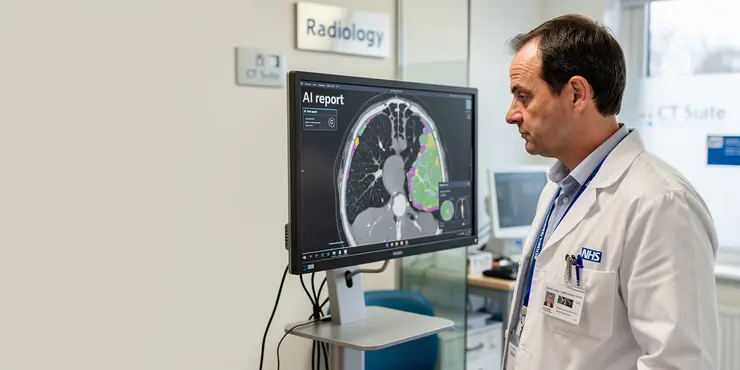
AI is revolutionizing how medical professionals approach lung cancer detection. With advancements in technology, AI algorithms are being trained to analyze medical imaging, such as CT scans, with high precision.
This capability helps in early detection, which is crucial for successful treatment outcomes. By identifying potential malignancies earlier than traditional methods, AI can potentially save many lives.
AI also reduces the workload of radiologists, who can focus their attention on cases flagged by AI, ensuring a more efficient workflow. This collaboration between AI and clinicians enhances diagnostic accuracy.
Enhancing Lung Cancer Treatment with Robotics
Robotics in surgery has become a cornerstone of modern lung cancer treatment. Robotic surgical systems offer greater precision and control, leading to minimally invasive procedures.
These systems can result in shorter recovery times and less postoperative pain for patients. As robotics technology evolves, its use in lung cancer surgeries is expected to increase, improving patient outcomes.
Moreover, robotic assistance aids in improving surgical precision, reducing the risk of complications during complex procedures. This is particularly valuable in delicate operations such as those involving lung tissues.
Integration of AI and Robotics
The synergy between AI and robotics offers promising advantages in lung cancer management. AI can enhance the functionality of robotic systems by providing real-time data analysis to guide surgical procedures.
This integration can lead to more accurate resections and better preservation of healthy tissues. As AI improves its ability to interpret surgical data, its collaboration with robotics could become a standard in the treatment of lung cancer.
Furthermore, AI-driven robotics can continually learn from past surgeries, refining techniques and outcomes, thus offering a significant leap forward in surgical oncology.
The Future Landscape in the UK
In the UK, the National Health Service (NHS) is recognising the transformative potential of AI and robotics. There is an increasing focus on integrating these technologies within the healthcare system.
Government and private sector investments in health tech promise advancements in AI and robotics for lung cancer. This could lead to earlier detection, better treatment options, and ultimately, improved survival rates.
As the UK gears up to tackle lung cancer with cutting-edge technology, patient-centric solutions backed by AI and robotics will likely become more prevalent, shaping the future of healthcare in profound ways.
Frequently Asked Questions
AI is currently used to analyze medical imaging, such as CT scans, to identify potential lung cancer nodules more accurately and quickly than traditional methods.
Robotics can enhance precision in surgeries, such as robot-assisted thoracic surgery, which allows for minimally invasive procedures with improved outcomes.
Advancements in machine learning algorithms and deep learning can improve the accuracy and speed of identifying and diagnosing lung cancer from medical images.
AI can analyze risk factors and genetic markers to help predict the likelihood of developing lung cancer, potentially allowing for earlier intervention.
AI can analyze patient data to tailor specific treatment plans, potentially leading to better outcomes by considering genetic, lifestyle, and other factors.
Yes, tools like ImageNet and Google's DeepMind are used to enhance radiological assessments and improve diagnostic accuracy.
Key considerations include patient privacy, the accuracy of AI predictions, potential bias in AI algorithms, and ensuring patients understand AI's role in their care.
By improving diagnostic accuracy and treatment precision, AI and robotics can reduce the need for repeat procedures and minimize complications, potentially lowering costs.
Limitations include the need for large, high-quality datasets, potential biases in training data, and challenges in integrating AI into clinical workflows.
AI can process and analyze large volumes of imaging data much faster than humans, allowing for quicker identification of potential cancerous lesions.
AI can analyze health records and imaging for early signs of lung abnormalities, potentially catching lung cancer signs at an earlier, more treatable stage.
AI can support remote diagnostics and monitoring, allowing for continuous assessment of patient health and early detection of complications through telemedicine platforms.
Robotics provide enhanced dexterity, precision, and control during surgeries, allowing for more accurate tumor removal with less damage to surrounding tissues.
Future developments may include more advanced robotic platforms with improved haptic feedback, autonomous or semi-autonomous functions, and greater adaptability to complex surgeries.
Challenges include integration into existing healthcare systems, ensuring accuracy and reliability, managing costs, and maintaining ethical standards and patient trust.
While AI provides valuable support in diagnostics, it is unlikely to replace human doctors due to the need for human judgment, oversight, and patient interaction.
AI can analyze imaging and patient data to track tumor response to treatment, helping doctors make informed decisions about the continuation or adjustment of therapy.
Healthcare professionals may need training in interpreting AI-generated data, operating robotic surgical systems, and integrating these technologies into patient care.
Improved accuracy in diagnostics and precision in treatment can lead to better management of the disease, fewer complications, and potentially higher survival rates.
Collaboration between technologists, healthcare professionals, researchers, and policymakers is essential to develop effective, safe, and ethically sound AI and robotic solutions.

Ergsy Search Results
This website offers general information and is not a substitute for professional advice.
Always seek guidance from qualified professionals.
If you have any medical concerns or need urgent help, contact a healthcare professional or emergency services immediately.
Some of this content was generated with AI assistance. We've done our best to keep it accurate, helpful, and human-friendly.
- Ergsy carefully checks the information in the videos we provide here.
- Videos shown by Youtube after a video has completed, have NOT been reviewed by ERGSY.
- To view, click the arrow in centre of video.
- Most of the videos you find here will have subtitles and/or closed captions available.
- You may need to turn these on, and choose your preferred language.
- Go to the video you'd like to watch.
- If closed captions (CC) are available, settings will be visible on the bottom right of the video player.
- To turn on Captions, click settings.
- To turn off Captions, click settings again.