
Speak To An Expert
Get clear, personalised advice for your situation.
Jot down a few questions to make the most of your conversation.
Introduction to Jury Selection
Jury selection is a crucial part of the legal process in the United Kingdom. It ensures that a fair and impartial jury is chosen to determine the outcome of a case based on the evidence presented in court. Jury duty is a civic responsibility, and those who are eligible may be called upon to serve.
Eligibility for Jury Service
In the UK, individuals eligible for jury service must be aged between 18 and 75, registered to vote, and have lived in the UK, the Channel Islands, or the Isle of Man for at least five consecutive years since their 13th birthday. Certain people may be disqualified or excused, such as those with specific mental health issues, those who have been sentenced to a term of imprisonment of five years or more, or those on bail.
Receiving a Jury Summons
When a person is randomly selected from the electoral register, they receive a jury summons through the post. This document includes the date and location of their required service. Failure to respond to a jury summons without a valid reason can result in a fine.
Jury Pool Selection
On the first day of jury service, potential jurors gather at the court and are briefed on their duties. They may watch an introductory video explaining the process and what is expected of them. Not everyone called will serve on a jury; some may be released if they are not needed or do not meet specific criteria during selection.
Selection for a Particular Trial
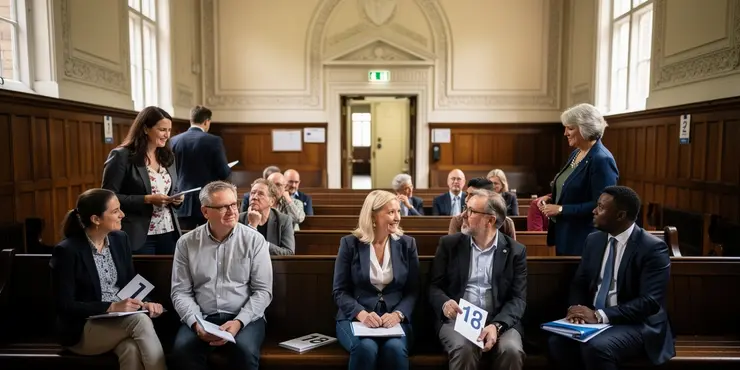
The process of selecting a jury for a specific trial involves randomly selecting names from the pool. The selected group is called into the courtroom, and the judge ensures they have no prior knowledge of the case or potential biases that could affect their judgment.
Challenges and Vetting
In some instances, both the prosecution and defense can challenge the selection of jurors. These challenges can be for cause if there is a reason to believe a juror cannot be impartial, or peremptory, which do not require a specific reason. In high-profile cases, more thorough vetting may take place to ensure a balanced jury.
Swearing In
Once a jury is agreed upon, each juror takes an oath or affirmation to faithfully try the defendant and give a true verdict according to the evidence. This marks the official start of the juror’s duties in the trial.
Conclusion
The jury selection process is fundamental to the justice system, designed to uphold fairness and impartiality. Serving as a juror is both a legal obligation and an opportunity to participate in a critical civic function, influencing the outcome of significant legal proceedings.
Introduction to Jury Selection
Choosing a jury is an important part of the law process in the UK. It makes sure that the jury is fair and has no bias. The jury will decide if someone is guilty or not, based on what they hear in court. Being on a jury is something citizens must do if called upon.
Eligibility for Jury Service
To be on a jury in the UK, you must be 18 to 75 years old, be registered to vote, and have lived in the UK, the Channel Islands, or the Isle of Man for at least five years since turning 13. Some people can't be on a jury, like those with certain mental health conditions or who have been in prison for five years or more, or who are on bail.
Receiving a Jury Summons
If you are chosen from the voter list, you will get a jury summons in the mail. This letter will tell you when and where you need to go. If you don’t reply without a good reason, you might have to pay a fine.
Jury Pool Selection
On the first day of jury duty, people who might be jurors come to court to learn about their role. They may watch a video that explains what to do. Not everyone will be on a jury; some might go home if they are not chosen or don't meet the requirements.
Selection for a Particular Trial
To pick a jury for a trial, names are chosen at random. The people chosen go into the courtroom, and the judge checks they know nothing about the case and can be fair.
Challenges and Vetting
Sometimes, the lawyers can ask not to have certain jurors. They might do this if they think a juror can't be fair, or without giving a reason. In big cases, they might look at jurors more closely to make sure there is a good mix.
Swearing In
When the jury is picked, each juror promises to listen to the case carefully and make a decision based on the facts. This is when the jurors start their job in the trial.
Conclusion
The process of picking a jury is very important to make sure the trial is fair. Being a juror is a duty and a chance to be part of the justice system. Jurors help decide important court cases.
Frequently Asked Questions
Jury selection is the process by which judges and lawyers choose jurors who will sit on a jury for a trial.
Potential jurors are usually selected from a pool drawn from voter registration lists, driver's license records, or other similar sources.
Voir dire is the process of questioning potential jurors to assess their suitability for serving on a jury.
Jurors are questioned to ensure they can be impartial, unbiased, and fair in deciding a case.
Questions may cover a juror's background, experiences, beliefs, and any potential biases or conflicts of interest.
Yes, lawyers can dismiss potential jurors through peremptory challenges or by showing cause for dismissal.
A peremptory challenge allows a lawyer to dismiss a potential juror without stating a reason, though it cannot be based on race or gender.
Dismissing a juror for cause means there is a specific, valid reason to believe the juror cannot be fair or impartial.
In a criminal trial, usually 12 jurors are selected, and in a civil trial, the number can vary, often being 6 to 12.
An alternate juror is a backup juror who serves if a regular juror becomes unable to complete the trial.
Yes, individuals can be excused from jury duty for reasons such as hardship, bias, or inability to understand the proceedings.
After the jury is selected, the trial begins with opening statements from the lawyers.
The length of jury selection can vary from a few hours to several days, depending on the complexity of the case.
The judge oversees the jury selection process, rules on challenges, and ensures the voir dire is conducted fairly.
Potential jurors generally do not ask questions, but they can request clarification if needed.
Jury selection is typically open to the public, as part of the public trial process, unless specific circumstances justify closure.
If not enough jurors are available, the court may call additional potential jurors from the jury pool or reschedule.
Jurors are typically randomly assigned to cases from the jury pool based on availability and selection.
Questioning about potential biases helps ensure that jurors can be impartial and fair when deliberating the case.
Jurors are informed of their selection by the court during the jury selection process, usually at the end of voir dire.
Jury selection is when judges and lawyers pick people to be on a jury for a trial.
People who might be picked for a jury are usually chosen from lists of people who can vote or lists of people with driver's licenses.
Voir dire is when lawyers ask questions to find out if someone can be a fair juror on a jury.
Jurors are asked questions to make sure they can be fair and not take sides when deciding a case.
Questions might ask about where a juror comes from, what they've done, what they believe in, and if they can be fair or if there's something that might make them not fair.
Yes, lawyers can ask some people to leave the jury. They can do this in two ways. They can use something called "peremptory challenges," or they can give a reason why the person should not be on the jury.
A peremptory challenge lets a lawyer say "no" to a person who might be on the jury. The lawyer doesn't have to say why. But the lawyer can't say "no" just because of a person’s race or if they are a boy or a girl.
Removing a juror for a reason means there is a good reason to think the juror cannot be fair or unbiased.
In a criminal trial, there are usually 12 people called jurors who decide if someone did something wrong.
In a civil trial, there can be different numbers of jurors, often from 6 to 12 people.
An alternate juror is a backup. They help if a regular juror cannot finish the trial.
Yes, people can skip jury duty for different reasons. Some reasons are having big problems, being unfair, or not able to understand what's happening in court.
After the jury is chosen, the trial starts. The lawyers talk first and explain what the trial is about.
Picking people for a jury can take a short time or a long time. It can be a few hours or even a few days. It depends on how difficult the case is.
Here's something that might help:
- Ask someone to read it with you.
- Use a dictionary to look up words you don’t know.
- Break the sentence into smaller parts to understand it better.
The judge is the person in charge. They help choose the people for the jury. The judge listens to any problems people have with the choices and makes sure everything is fair.
You can use tools like text-to-speech to hear the words spoken aloud. Highlighting text can also help you focus on each part.
People who might serve as jurors don't usually ask questions, but they can ask if they don't understand something.
Picking a jury is usually done where people can watch. This is part of making trials open for everyone, unless there is a special reason to do it in private.
If there are not enough jurors, the court will ask more people from a group of potential jurors to come or choose a new date for the trial.
Jurors are picked by chance from a big group of people. They are chosen based on who is free and who is picked for the case.
Asking questions about biases helps make sure that jurors can be fair and honest when they talk about the case.
Jurors find out they are chosen by the court at the end of the jury selection process.

Ergsy Search Results
This website offers general information and is not a substitute for professional advice.
Always seek guidance from qualified professionals.
If you have any medical concerns or need urgent help, contact a healthcare professional or emergency services immediately.
Some of this content was generated with AI assistance. We've done our best to keep it accurate, helpful, and human-friendly.
- Ergsy carefully checks the information in the videos we provide here.
- Videos shown by Youtube after a video has completed, have NOT been reviewed by ERGSY.
- To view, click the arrow in centre of video.
- Most of the videos you find here will have subtitles and/or closed captions available.
- You may need to turn these on, and choose your preferred language.
- Go to the video you'd like to watch.
- If closed captions (CC) are available, settings will be visible on the bottom right of the video player.
- To turn on Captions, click settings.
- To turn off Captions, click settings again.