
Speak To An Expert
Get clear, personalised advice for your situation.
Jot down a few questions to make the most of your conversation.
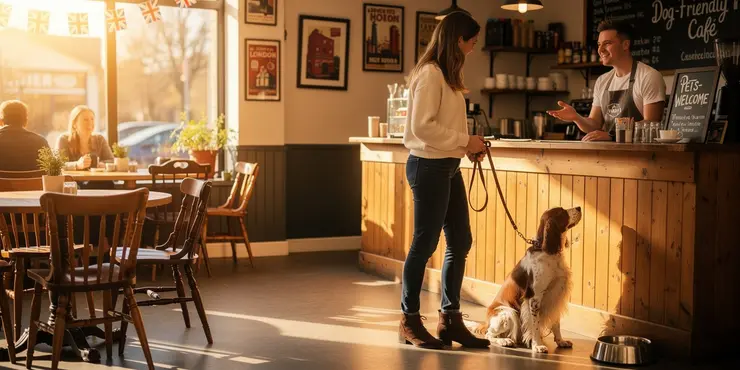
Check the venue’s dog policy first
Before you set off, look up the shop, cafe, or transport provider’s rules for dogs. In the UK, policies can vary widely, even between branches of the same chain.
Some places welcome dogs, while others allow only assistance dogs or have specific size restrictions. A quick check online or a phone call can save you time and avoid embarrassment.
Think about cleanliness and hygiene
Make sure your dog is clean, dry, and free from mud before going indoors. This is especially important in cafes, where food is being served nearby.
Bring wipes or a towel in case your dog gets dirty on the way. If your dog has been rolling in something smelly or has loose hair, it may be better to leave them at home.
Assess your dog’s behaviour
Your dog should be calm around strangers, noises, food, and other dogs. Busy shops and stations can be stressful, so a nervous or reactive dog may struggle.
They should also be able to walk on a lead without pulling and settle quietly at your feet. If your dog barks, jumps up, or becomes overexcited, it may not be the right outing.
Pack the right essentials
Take a short lead, poo bags, water, and a portable bowl if you may be out for a while. A small mat or blanket can help your dog settle in a cafe.
Carry treats for good behaviour, but avoid feeding in a way that might bother other customers. If travelling by public transport, keep everything easy to access so you can manage your dog quickly.
Be aware of space and safety
In shops and cafes, make sure your dog will not block walkways or create a trip hazard. On buses, trains, and tubes, your dog should be able to stay close to you and out of the way of other passengers.
Consider whether your dog is comfortable with crowds, luggage, pushchairs, and sudden movement. If space is tight, it may be kinder and safer to leave them at home.
Respect other people
Not everyone likes dogs, and some people may be allergic or anxious. Keep your dog under control, do not let them approach people without permission, and always ask before allowing interaction.
If your dog makes a mess, barked repeatedly, or disturbed others, be ready to leave promptly. Good manners help make dogs more welcome in public places across the UK.
Frequently Asked Questions
Rules vary by venue and transport provider, but dogs are often allowed if they are clean, controlled, and do not create a nuisance. Assistance dogs usually have broader access rights, while other dogs may be restricted in some shops, cafes, or on certain public transport services.
Yes. Assistance dogs are typically given legal access rights that are not available to pet dogs. Shops, cafes, and public transport operators usually must make reasonable adjustments to allow assistance dogs, subject to safety and hygiene exceptions.
No. Whether dogs can be brought in depends on the specific shop, cafe, or transport operator, as well as local laws. Some places welcome pets, some allow only assistance dogs, and some prohibit dogs entirely.
Staff may check whether the dog is an assistance dog, whether it is under control, and whether it poses any hygiene or safety concern. On public transport, staff may also check if the dog meets carrier, muzzle, or ticket requirements where applicable.
Shops do not always need to allow pet dogs, but they often must allow assistance dogs where the law requires it. Individual businesses can set their own pet policies, provided they do not unlawfully discriminate against assistance dog users.
Cafes may choose their own pet policy, but they usually must permit assistance dogs. Some cafes welcome pet dogs in outdoor areas or designated spaces, while others ban all dogs except assistance dogs.
Public transport rules depend on the operator and the type of service. Some buses, trains, and taxis allow dogs if they are controlled and do not disturb others, while others may restrict them or require a muzzle, lead, or carrier.
A shop may refuse pet dogs on hygiene grounds if its policy or local rules allow it. However, hygiene concerns usually cannot be used to refuse an assistance dog unless there is a specific legal or safety reason.
A cafe may need to balance allergy concerns with access rights. If the dog is an assistance dog, the cafe should usually make reasonable adjustments rather than refuse access automatically, while for pet dogs the cafe may set a stricter policy.
Pet dogs usually do not need special documentation, though some venues may ask for proof of vaccination or registration rules. Assistance dog users are generally not required to carry formal certification, but may be asked appropriate questions to confirm the dog’s role.
The dog should normally be on a lead, harness, or otherwise under effective control, unless the owner has a valid reason to use another method. The dog should remain calm, not block walkways, and not disturb customers or passengers.
Yes, if the dog is barking, whining, or otherwise disturbing the environment, staff may ask the owner to control the dog or leave. This is especially likely for pet dogs, while assistance dogs are expected to remain well behaved and under control.
Puppies are usually treated like other dogs and must follow the same venue or transport rules. Some places may allow puppies, but they may be refused if they are not fully controlled, trained, or suitable for the location.
Owners should check the business or transport operator's pet policy in advance, confirm any local restrictions, and ensure the dog is clean, vaccinated, and under control. It is also helpful to carry water, waste bags, and any required items such as a lead or muzzle.
This depends on local law and the specific policy in place. Some laws only cover assistance dogs, while others may recognize additional service animals. The term here focuses on dogs, so the relevant rights and checks usually apply to dogs specifically.
The owner may be responsible for any damage caused by the dog, including cleaning or repair costs. Businesses and transport operators may also ask the owner to remove the dog if it is behaving unsafely or destructively.
Yes, staff can usually ask reasonable questions, especially if they need to confirm whether the dog is an assistance dog or whether it is allowed on the service. Questions should be relevant and not intrusive.
Yes. Even where dogs are generally allowed, access can be limited if there is a genuine health or safety concern, such as food preparation areas, crowding, or an aggressive dog. Assistance dogs are still usually protected unless a serious risk exists.
Yes. Local laws can change whether dogs are allowed, what checks are required, and how assistance dogs must be treated. Always check the rules that apply in the specific area before going out with a dog.
Owners should confirm the policy in advance, keep the dog clean and controlled, respect staff instructions, and be ready to leave if the venue does not allow dogs. Planning ahead reduces the chance of refusal or conflict.

Ergsy Search Results
This website offers general information and is not a substitute for professional advice.
Always seek guidance from qualified professionals.
If you have any medical concerns or need urgent help, contact a healthcare professional or emergency services immediately.
Some of this content was generated with AI assistance. We've done our best to keep it accurate, helpful, and human-friendly.
- Ergsy carefully checks the information in the videos we provide here.
- Videos shown by Youtube after a video has completed, have NOT been reviewed by ERGSY.
- To view, click the arrow in centre of video.
- Most of the videos you find here will have subtitles and/or closed captions available.
- You may need to turn these on, and choose your preferred language.
- Go to the video you'd like to watch.
- If closed captions (CC) are available, settings will be visible on the bottom right of the video player.
- To turn on Captions, click settings.
- To turn off Captions, click settings again.