
Speak To An Expert
Get clear, personalised advice for your situation.
Jot down a few questions to make the most of your conversation.
Understanding Your Rights
If you feel that your neighbour's CCTV is infringing on your privacy, it's important to understand your rights in the UK. The use of CCTV is governed by the Data Protection Act 2018 and the General Data Protection Regulation (GDPR). These regulations mean that if a CCTV camera captures images outside the boundary of the homeowner’s property, the footage is subject to data protection laws. This includes capturing images of your property, yourself, or your family.
Communicate with Your Neighbour
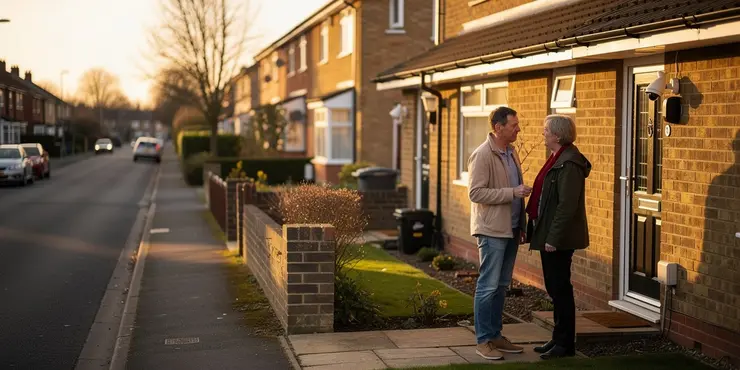
Your first step should be to speak directly with your neighbour. It's possible they are unaware that their CCTV system is affecting your privacy. Approach the conversation diplomatically and express your concerns. It can be helpful to suggest ways to resolve the issue, such as redirecting the camera or utilizing privacy masking features that many modern CCTV systems offer. Often, a simple conversation can lead to a quick resolution without any further action needed.
Check the CCTV System
It's advisable to check whether the CCTV system is recording beyond the neighbour's property boundaries. Ask the neighbour how their CCTV system works, such as the areas it records and how long footage is retained. Under the Data Protection Act, they are required to justify the collection of images and ensure they are used proportionately.
Contact the Information Commissioner's Office (ICO)
If discussing your concerns with your neighbour does not resolve the issue, you can take the matter to the Information Commissioner's Office (ICO). The ICO oversees data protection laws in the UK and can offer guidance on next steps if you feel your privacy rights are being breached. You may need to provide evidence of your attempts to resolve the issue directly with your neighbour.
Consider Legal Advice
In cases where a resolution is not reached through direct communication or intervention by the ICO, you may consider seeking legal advice. A solicitor can provide guidance on whether you have grounds to pursue a legal claim based on privacy breaches or harassment. Keep records of all interactions with your neighbour and any advice given by the ICO, as this documentation may be helpful if you decide to proceed legally.
Mediation Services
Another option is to use mediation services to resolve disputes with your neighbour regarding CCTV use. Mediators provide a neutral platform for both parties to find an agreeable solution. Many communities have free or low-cost neighbourhood mediation services that could prove beneficial.
Know Your Rights
If you think your neighbour's CCTV is watching you when it shouldn't, you need to know what you can do. In the UK, we have rules about cameras. These rules are called the Data Protection Act 2018 and GDPR. If the camera sees outside your neighbour's home, like your garden or family, it must follow these rules.
Talk to Your Neighbour
The first thing you should try is talking to your neighbour. They might not know their camera is bothering you. Be polite when you talk to them. Tell them how you feel. You could ask them to move the camera or use special settings so it doesn't see your space. Usually, a simple chat can fix the problem.
Look at the CCTV Setup
Find out if the camera is seeing extra areas. Ask your neighbour how the camera works — like where it is looking and how long they keep the videos. The law says they need a good reason to film and must use the video fairly.
Contact the Information Commissioner’s Office (ICO)
If talking doesn't help, you can ask the Information Commissioner's Office (ICO) for help. ICO makes sure camera rules are followed in the UK. They can tell you what to do next if you think your area is being filmed wrongly. Keep any notes of chats you've had with your neighbour to show the ICO.
Think About Legal Help
If nothing works, you might need to talk to a lawyer. They can tell you if you can make a legal complaint because of privacy problems. Keep records of what you talk about with your neighbour and any help you get from ICO. This will be useful if you take legal steps.
Use Mediation Services
You can also try using mediation services. A mediator helps you and your neighbour find a way to agree. There are often free or cheap local services that can help with camera problems.
Frequently Asked Questions
Start by talking to your neighbor to express your concerns about their CCTV system.
Check the camera's field of view to see if it captures images beyond their property, such as your yard or windows.
Laws vary by location, but generally, cameras should not intrude on your reasonable expectation of privacy.
Explain how the cameras affect your privacy and suggest possible adjustments to their setup.
Consider mediating through a neutral third party or seeking advice from local authorities.
Yes, taking photos or videos of the camera positions can be helpful if legal advice becomes necessary.
Local law enforcement, city council, or data protection agencies may provide guidance on privacy laws.
Direct action like blocking or damaging the camera is not advisable and may be illegal.
Privacy screens or strategic landscaping such as trees can obstruct unwanted views.
Recording audio often has stricter regulations and might require consent from those recorded.
Yes, they may have rules or guidelines concerning security cameras and privacy that could be enforced.
If the situation doesn’t improve after talking to your neighbor and local authorities, consider consulting a lawyer.
You may be able to seek an injunction to have the CCTV repositioned or removed.
This legal principle implies that certain private areas should not be subject to surveillance without permission.
There are technologies like privacy window films, but modifying captured footage directly raises legal issues.
Mediation might help reach a compromise or agreement outside of a legal setting.
Data protection laws might regulate how CCTV footage is collected, used, and stored.
Yes, security experts can offer an assessment in terms of legal compliance and best practices.
Installing privacy curtains, blinds, or outdoor privacy screens can limit any unwanted visual intrusion.
If informal approaches fail, reporting the issue to local authorities can be a good step for community level resolution.
First, go and talk to your neighbor. Tell them why you are worried about their CCTV camera.
Look at where the camera can see. Check if it can take pictures of places outside their home, like your yard or windows.
Laws are different in each place, but mostly, cameras should not go where you expect to be private.
Let's talk about how cameras might affect your privacy and some ways to fix it.
Think about asking someone who is not involved to help both sides talk. You can also ask local leaders or helpers for advice.
Yes, taking pictures or videos of where the cameras are can help if you need to talk to a lawyer.
Ask the police, city leaders, or data protection groups about privacy rules. They can help you understand them.
Do not block or break the camera. This might be against the law.
You can use special screens or plant trees and bushes to block views you don’t want.
When you record sound, there are often more rules to follow. You might need to ask people if they are okay with being recorded.
Yes, they might have rules about security cameras and privacy.
If things don't get better after you talk to your neighbor and get help from local helpers, you might want to speak to a lawyer. A lawyer is someone who knows a lot about rules and can help you understand what to do next.
You might be able to ask for help to move or take away the CCTV camera.
This rule says that some places should stay private. No one should watch or listen without asking first.
There are special window stickers that can help keep things private. But changing videos that you take can cause legal problems.
Mediation is a way to help people agree or find a middle ground without going to court.
There are rules about how to use CCTV cameras. These rules say how pictures and videos are taken, used, and kept safe.
Yes, safety experts can help check if things follow the law and the best ways to do things.
Put up curtains, blinds, or screens to keep people from seeing in.
If talking about the problem doesn't work, you can tell someone in charge, like the local council. They can help fix the problem for everyone.

Ergsy Search Results
This website offers general information and is not a substitute for professional advice.
Always seek guidance from qualified professionals.
If you have any medical concerns or need urgent help, contact a healthcare professional or emergency services immediately.
Some of this content was generated with AI assistance. We've done our best to keep it accurate, helpful, and human-friendly.
- Ergsy carefully checks the information in the videos we provide here.
- Videos shown by Youtube after a video has completed, have NOT been reviewed by ERGSY.
- To view, click the arrow in centre of video.
- Most of the videos you find here will have subtitles and/or closed captions available.
- You may need to turn these on, and choose your preferred language.
- Go to the video you'd like to watch.
- If closed captions (CC) are available, settings will be visible on the bottom right of the video player.
- To turn on Captions, click settings.
- To turn off Captions, click settings again.