
Speak To An Expert
Get clear, personalised advice for your situation.
Jot down a few questions to make the most of your conversation.
What counts as strength training?
Strength training, sometimes called muscle-strengthening activity, is exercise that makes your muscles work harder than usual. It helps build strength, support healthy bones, improve posture, and make everyday activities feel easier.
It does not always mean lifting heavy weights in a gym. Bodyweight exercises, resistance bands, free weights, machines, and even activities like climbing can all count if they challenge the muscles.
UK weekly recommendations for adults
For adults in the UK, the main exercise guideline is at least 150 minutes of moderate-intensity activity each week, or 75 minutes of vigorous activity, or a mix of both. On top of this, adults should do strength exercises that work all major muscle groups on at least two days a week.
These muscle groups include the legs, hips, back, abdomen, chest, shoulders, and arms. The idea is to spread strength work across the body, not just focus on one area.
Examples include squats, lunges, press-ups, sit-to-stands, planks, weight training, and resistance band exercises. Doing these activities regularly can help maintain muscle mass as people get older.
UK weekly recommendations for children and young people
Children and young people aged 5 to 18 are advised to be active for an average of at least 60 minutes each day. This should mostly be moderate to vigorous activity, and it should include activities that strengthen muscles and bones at least three days a week.
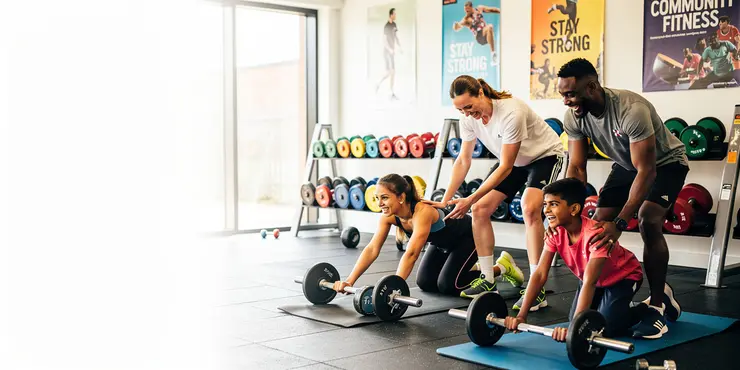
For children, strength training does not usually mean formal gym sessions. It can include climbing, skipping, gymnastics, football, jumping games, and playground activities that use body weight and movement.
More structured strength exercises can also be suitable when supervised properly and matched to age and ability. The focus should be on good technique, confidence, and enjoyment rather than heavy loads.
Safe and practical ways to include strength work
Strength training can be built into a weekly routine without needing much equipment. Simple home exercises, park workouts, sports, or short resistance sessions can all help meet the recommendations.
Adults should choose movements that challenge them while still allowing good form. Children should stay active through playful, varied movement, with adults or coaches making sure the activity is safe and appropriate.
If someone is new to exercise or has a health condition, it may help to start gradually. The key is consistency, with strength training forming a regular part of an overall active week.
Frequently Asked Questions
For adults, strength training is generally recommended at least 2 days per week, targeting major muscle groups. For children and adolescents, muscle-strengthening activities are recommended at least 3 days per week as part of a broader daily activity routine.
Adults are typically advised to do strength training on 2 or more days per week. Children and adolescents are generally advised to include muscle-strengthening activity on at least 3 days per week.
Strength training supports muscle strength, bone health, movement skills, posture, and overall function. It can also help adults maintain independence and help children build healthy movement habits.
Body-weight exercises, resistance bands, free weights, machines, climbing, push-ups, squats, and supervised sports or play that build muscles can count toward strength training recommendations.
The intensity should be appropriate for age and ability. Adults can use moderate to challenging resistance with good form, while children should focus on safe, age-appropriate, playful, and supervised resistance activities rather than maximal lifting.
Beginners should start with light resistance, simple movements, and fewer sets, then gradually increase frequency, resistance, or complexity as technique and confidence improve.
Use proper technique, warm up before activity, progress gradually, avoid pain, and supervise children closely. If there are medical concerns or injuries, a qualified professional should be consulted.
Yes, strength training can be done at home using body-weight exercises, bands, or light equipment. Home routines can be effective if they are planned, age-appropriate, and performed with good form.
No equipment is required for many exercises, especially for children and beginners. Adults may benefit from resistance bands, dumbbells, kettlebells, or machines, but body-weight exercise can also meet the recommendation.
The total time can vary. Adults may complete 20 to 60 minutes per session depending on goals and fitness level, while children often benefit from shorter, frequent, playful strength-focused activities integrated into active play.
Yes, strength training should be combined with aerobic activity for a well-rounded routine. Many people do both in the same week, and children should also get plenty of active play and movement throughout the day.
People with pain, recent injuries, certain chronic conditions, or other medical concerns should seek guidance before starting. Children with special health needs should be supervised and may need individualized advice.
Strength training places healthy stress on muscles and bones, which can help improve or maintain bone strength. This is especially valuable during childhood and adolescence when bones are still developing.
The general recommendations are the same for boys and girls, though individual needs, abilities, and interests may differ. The goal is regular, safe, age-appropriate muscle-strengthening activity for everyone.
Strength training can support healthy weight management by preserving or building muscle and improving overall activity levels. It works best alongside balanced nutrition and regular physical activity.
Parents can encourage active play, model exercise habits, provide safe equipment, supervise sessions, and make activity fun and consistent. For children, positive reinforcement is often more effective than pressure.
School settings can include climbing, games that use pushing and pulling, body-weight circuits, obstacle courses, and supervised strength-related physical education activities that are age-appropriate and safe.
Yes, too much training or poor recovery can lead to fatigue or injury. Rest days, proper technique, and gradual progression are important, especially when combining strength training with other sports or activities.
Younger children should focus on basic movement skills and playful body-weight activities, while older children and teens can gradually add more structured resistance work. Adults should adjust volume and intensity based on fitness, health, and recovery.
Reliable guidance is available from licensed health professionals, certified fitness professionals, pediatric resources, and public health organizations. It is best to use age-appropriate recommendations from trusted medical or fitness sources.

Ergsy Search Results
This website offers general information and is not a substitute for professional advice.
Always seek guidance from qualified professionals.
If you have any medical concerns or need urgent help, contact a healthcare professional or emergency services immediately.
Some of this content was generated with AI assistance. We've done our best to keep it accurate, helpful, and human-friendly.
- Ergsy carefully checks the information in the videos we provide here.
- Videos shown by Youtube after a video has completed, have NOT been reviewed by ERGSY.
- To view, click the arrow in centre of video.
- Most of the videos you find here will have subtitles and/or closed captions available.
- You may need to turn these on, and choose your preferred language.
- Go to the video you'd like to watch.
- If closed captions (CC) are available, settings will be visible on the bottom right of the video player.
- To turn on Captions, click settings.
- To turn off Captions, click settings again.