
Get Answers
Introduction to the Social Media Ban
The debate over a social media ban, especially for young people, has been growing in the UK. Concerns around mental health and safety have driven this conversation. Schools play a crucial role in this ongoing discussion and its implementation.
While the ban aims to protect students, schools are tasked with supporting and educating them. This involves understanding the complexities of digital spaces.
Educational Initiatives
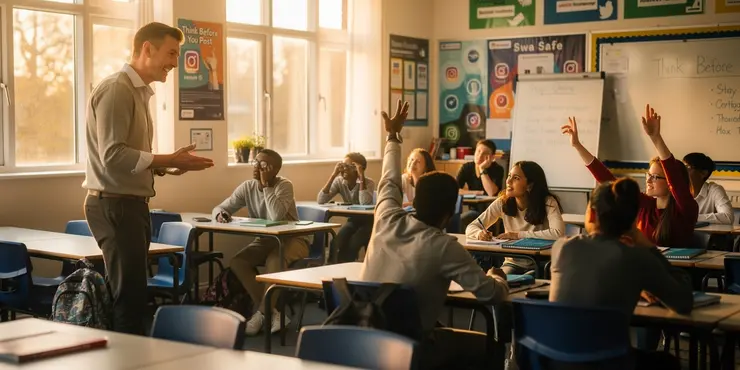
Schools are essential in providing digital literacy education. They can teach students about the benefits and pitfalls of social media. This education helps students make informed decisions about their online presence.
By integrating social media awareness into the curriculum, schools help students develop critical thinking skills. This approach enables students to navigate digital platforms responsibly even if a ban is implemented.
Creating a Supportive Environment
Supportive school environments can be a buffer against the negative impacts of social media. Schools can provide a sense of community and belonging, reducing the allure of online validation. This helps in mitigating the need for social media engagement.
By fostering open communication, schools can assist students in discussing online issues. This can include counselling services and support groups, which provide safe spaces for students to express their concerns.
Collaborating with Parents
Schools can serve as a bridge between students and parents on social media issues. By holding workshops and discussions, schools can educate parents about the potential risks and benefits of social media. This collaboration ensures a unified approach to managing digital consumption.
Engaging parents helps reinforce the guidelines and teachings provided at school. Consistent messaging at home and in school is crucial for the effectiveness of any social media restrictions.
Navigating Technological Challenges
Implementing a social media ban requires technological considerations. Schools need to work with technology providers to monitor and limit access to social media on school devices and networks. This ensures that the ban is effective during school hours.
Educators must also stay informed about technological trends and tools. Understanding these tools helps in effectively communicating with students about safe online practices.
Conclusion
The role of schools in supporting a social media ban is multifaceted. Schools are not just enforcers of rules but are also educators and supporters. Their involvement is crucial to the success of such initiatives.
By educating, supporting, and collaborating with all stakeholders, schools can help create a safer digital environment for students. Their pivotal role ensures that students benefit from a balanced and informed approach to social media use.
Frequently Asked Questions
The social media ban in schools refers to policies or regulations that restrict or limit students' access to social media platforms during school hours to minimize distractions and protect student well-being.
Schools support a social media ban to reduce distractions, prevent cyberbullying, improve academic focus, and promote healthier interpersonal interactions among students.
Schools enforce a social media ban by implementing policies that restrict access to social media sites on school Wi-Fi, supervising students, and educating them about the responsible use of technology.
Teachers support the social media ban by monitoring students' use of devices, integrating digital literacy into the curriculum, and modeling appropriate technology use.
Schools cannot control students' social media usage at home, but they can educate students and parents about healthy digital habits and encourage responsible use outside school hours.
Benefits include increased focus on learning, reduced incidents of cyberbullying, improved mental health, and enhanced face-to-face social skills among students.
Schools communicate the social media ban to parents through newsletters, meetings, policy handbooks, and outreach programs that explain the rationale and benefits.
Schools address violations by implementing a disciplinary process that may include warnings, discussions with students, involving parents, and, in some cases, revoking device privileges.
Challenges include varying technology policies, students using personal data plans that bypass school networks, and balancing enforcement with educational goals.
Some schools may allow exceptions for educational purposes where social media platforms are used as learning tools under teacher guidance.
Schools integrate digital citizenship by teaching students about online safety, privacy, digital etiquette, and the long-term impact of digital footprints.
Not all schools implement a social media ban, as policies vary based on the school's philosophy, technology infrastructure, and community values.
Schools measure effectiveness by monitoring academic performance, examining behavioral data, conducting surveys, and receiving feedback from teachers, students, and parents.
School administrators develop and enforce technology policies, provide resources for teachers and students, and engage with parents to ensure the social media ban is effective.
A social media ban can lead to increased face-to-face interactions, more focused communication, and reduced opportunities for distraction in student-teacher interactions.
Schools handle this by integrating controlled access during specific times and ensuring it aligns with educational objectives under teacher supervision.
Student reactions can vary; some may appreciate the reduced distractions, while others might resist or find workarounds to access social media.
Schools provide counseling, educational workshops, and alternative channels for socialization and expression to help students adjust to a social media ban.
Parents can support schools by reinforcing digital safety rules at home, monitoring their child's social media use, and communicating with schools about their policies.
Schools engage the community by holding workshops, information sessions, and forum discussions to address concerns and gather input on social media policies.

Ergsy Search Results
This website offers general information and is not a substitute for professional advice.
Always seek guidance from qualified professionals.
If you have any medical concerns or need urgent help, contact a healthcare professional or emergency services immediately.
Some of this content was generated with AI assistance. We've done our best to keep it accurate, helpful, and human-friendly.
- Ergsy carefully checks the information in the videos we provide here.
- Videos shown by Youtube after a video has completed, have NOT been reviewed by ERGSY.
- To view, click the arrow in centre of video.
- Most of the videos you find here will have subtitles and/or closed captions available.
- You may need to turn these on, and choose your preferred language.
- Go to the video you'd like to watch.
- If closed captions (CC) are available, settings will be visible on the bottom right of the video player.
- To turn on Captions, click settings.
- To turn off Captions, click settings again.