
Get Answers
Introduction
AI models are increasingly used to aid in the diagnosis and treatment of lung cancer. These models rely on data to learn and improve their accuracy. Therefore, understanding the data requirements is essential for their effective deployment.
Lung cancer is a major health concern in the UK, necessitating efficient diagnostic tools. AI models can potentially improve the speed and accuracy of diagnosis. Consequently, data availability becomes a significant factor in their performance.
Data Requirements for Training
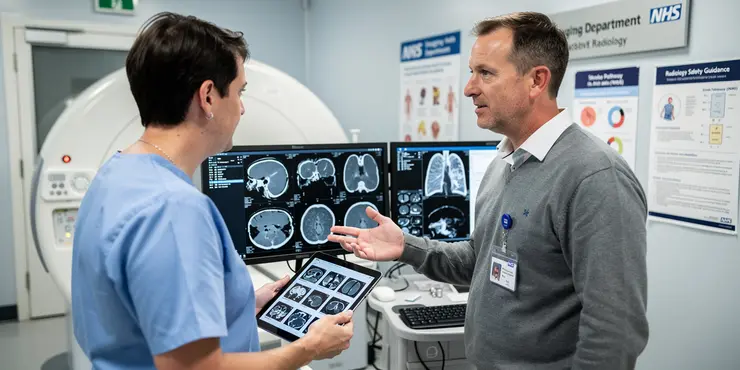
Training AI models for lung cancer involves processing vast amounts of data. High-quality medical images, such as CT scans, are crucial for these models. This ensures that the AI can accurately identify patterns associated with the disease.
The size of the dataset directly impacts the model's effectiveness. More data typically allows the AI to generalize better and make more accurate predictions. However, acquiring large datasets can be challenging due to privacy and logistical issues.
Data Challenges and Solutions
Data scarcity is a common challenge in healthcare AI applications. Privacy regulations and data collection costs often limit data availability. This is particularly true for specialised medical data like lung cancer scans.
To address this, researchers are exploring data augmentation techniques. These methods artificially expand existing datasets, helping models learn from a broader range of examples. Additionally, collaborations between hospitals can increase data access.
The Importance of Data Quality
While the quantity of data is crucial, quality cannot be ignored. Poor quality or biased data can lead to inaccurate AI predictions. Ensuring diverse and representative datasets is essential for reliable AI models.
Data should encompass various demographics and disease stages. This diversity helps models perform well across different patient populations and settings. Efforts are ongoing in the UK to standardise data collection in healthcare.
Conclusion
AI models for lung cancer do require substantial amounts of data to achieve optimal performance. Balancing data quantity with quality is essential for developing effective diagnostic tools. Advances in data sharing and augmentation continue to aid this effort.
For the UK healthcare system, investing in data infrastructure and collaboration is critical. As AI technology progresses, these models can play a pivotal role in improving lung cancer outcomes.
Frequently Asked Questions
Yes, AI models typically require a significant amount of data to train effectively, especially in the field of medical diagnostics like lung cancer.
Data from medical imaging (such as CT scans), patient history, genetic information, and biopsy results are commonly used to train AI models for lung cancer detection.
A large dataset is crucial for training AI models because it helps the model learn the complex patterns and variations present in lung cancer, thus improving its accuracy and generalization abilities.
High-quality data ensures that the AI models are trained on accurate and reliable information, leading to better performance and more trustworthy predictions.
Training AI models with limited data is challenging and can lead to overfitting or poor generalization. Techniques such as data augmentation and transfer learning may help, but a larger dataset is generally preferable.
Challenges include privacy concerns, data variability, the need for labeled data, and ensuring that the dataset is representative of diverse patient populations.
Yes, there are public datasets like the Lung Image Database Consortium (LIDC) that are used for training AI models in lung cancer detection.
Data preprocessing is essential to clean and normalize the data, enhance image quality, and remove noise, which can significantly impact the performance of AI models.
The amount of data considered sufficient can vary depending on the complexity of the model and the variability of the data, but thousands of labeled examples are typically desired.
Insufficient data can lead to poor model performance, overfitting, and an inability to generalize to new, unseen data, potentially impacting the accuracy of lung cancer detection.
Yes, synthetic data can be used to augment training datasets and help in situations where real-world data is scarce, but it must be carefully designed to be accurate and reliable.
Labeled data is crucial as it helps to train supervised learning models, enabling them to learn the relationship between input data and the correct output.
Diverse data helps ensure that the AI model is robust and can generalize across different patient demographics, cancer types, medical imaging devices, and clinical scenarios.
Advancements in data collection, such as improved imaging technologies and data integration systems, can provide higher quality, more comprehensive datasets for training AI models.
Transfer learning involves using a pre-trained model on a large dataset and fine-tuning it for a specific task such as lung cancer detection, thereby reducing the amount of data required.
Privacy concerns can limit data sharing and availability, making it challenging to compile large and diverse datasets necessary for training robust AI models.
Strategies include using transfer learning, data augmentation, generating synthetic data, and creating collaborative data-sharing agreements between institutions.
Data heterogeneity, which includes variations in imaging techniques and patient demographics, can introduce complexity but also improve a model's robustness and generalizability.
Continuous data collection allows AI models to be updated with the latest information, helping them stay accurate and effective as medical knowledge and technologies evolve.
Ensuring data quality involves rigorous data cleaning, verification processes, standardization of data formats, and inclusion of comprehensive metadata to improve the model’s efficiency and reliability.

Ergsy Search Results
This website offers general information and is not a substitute for professional advice.
Always seek guidance from qualified professionals.
If you have any medical concerns or need urgent help, contact a healthcare professional or emergency services immediately.
Some of this content was generated with AI assistance. We've done our best to keep it accurate, helpful, and human-friendly.
- Ergsy carefully checks the information in the videos we provide here.
- Videos shown by Youtube after a video has completed, have NOT been reviewed by ERGSY.
- To view, click the arrow in centre of video.
- Most of the videos you find here will have subtitles and/or closed captions available.
- You may need to turn these on, and choose your preferred language.
- Go to the video you'd like to watch.
- If closed captions (CC) are available, settings will be visible on the bottom right of the video player.
- To turn on Captions, click settings.
- To turn off Captions, click settings again.