
Get Answers
Introduction to AI in Lung Cancer Detection
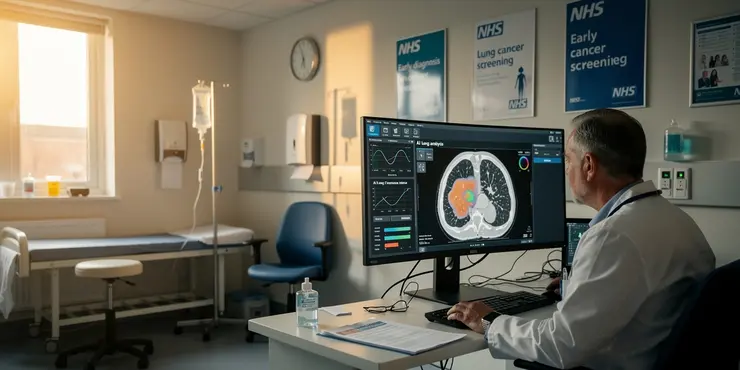
Artificial intelligence (AI) is revolutionising medical imaging and diagnostics. This is especially true in the field of lung cancer detection.
AI improves the accuracy and efficiency of analysing imaging data. Various types of imaging data are integral to early detection and treatment planning.
Computed Tomography (CT) Scans
Computed tomography (CT) is a primary method for lung cancer screening. It provides detailed images of the lungs and surrounding tissues.
AI algorithms analyse CT scan data to identify potential tumours. These algorithms detect nodules that might be missed by the human eye.
The precision of AI in CT scans can help reduce false positives and negatives. This aids in early and accurate lung cancer diagnosis.
X-rays
X-rays are one of the oldest imaging techniques used for lung examination. However, they are less detailed than modern CT scans.
AI enhances the analysis of X-ray images by detecting subtle changes. This is crucial for identifying early signs of lung cancer.
By applying AI, radiologists can quickly verify suspicious findings on X-rays. This improves the workflow and speeds up the diagnostic process.
Magnetic Resonance Imaging (MRI)
Magnetic resonance imaging (MRI) is less commonly used for lung cancer. However, it provides high-contrast images of soft tissues.
AI can assist in analysing MRI data for detailed tumour characteristics. This is useful in complex cases where precise imaging is required.
Using AI in MRI analysis helps in assessing the extent of cancer spread. It also aids in planning more effective treatment strategies.
Positron Emission Tomography (PET)
Positron emission tomography (PET) is often used alongside CT scans. It helps in evaluating the metabolic activity of lung tissues.
AI algorithms can interpret PET data to assess tumour aggressiveness. They support clinicians in making informed decisions about treatment.
PET analysis through AI contributes to personalised treatment plans. This ensures that patients receive the most appropriate care.
Future Prospects and Challenges
AI continues to advance in the field of medical imaging. The potential for increased accuracy and efficiency is vast.
However, integrating AI into clinical practice presents challenges. Ensuring data privacy and addressing ethical concerns are crucial steps.
Overall, AI holds the promise of transforming lung cancer detection. Continued research and innovation will enhance its clinical applications.
Frequently Asked Questions
AI models typically analyze CT scans, chest X-rays, and sometimes PET scans for lung cancer detection.
CT scans provide detailed cross-sectional images of the lungs, allowing AI models to detect even small nodules.
Yes, AI can analyze chest X-rays to detect abnormalities or nodules that may indicate lung cancer, although it is generally less detailed than CT scans.
Yes, PET scans can be used to analyze metabolic activity in lung tissues, helping to identify potential cancerous areas.
AI algorithms can detect patterns, classify tissue types, and flag potential abnormalities that radiologists might miss.
Deep learning techniques, such as convolutional neural networks, are used to automatically extract features and classify images.
Yes, AI can help minimize false positives by accurately distinguishing between benign and malignant nodules.
AI analysis can be very accurate and is often used to complement the expertise of radiologists.
Challenges include variability in data quality, the need for large annotated datasets, and ensuring model generalizability.
AI can be trained to analyze various imaging modalities by learning specific features and patterns associated with each type.
Yes, AI models can complement radiologists' work by providing quick assessments and ensuring comprehensive analysis.
AI models are trained on diverse datasets to ensure they can handle variations in scanning protocols and imaging conditions.
Yes, some AI models are optimized for real-time analysis to provide immediate feedback during diagnostic procedures.
AI systems use a combination of morphological analysis and pattern recognition to distinguish between different types of nodules.
AI can assist in pre-surgical planning by providing detailed anatomical insights and predicting surgical outcomes.
Some AI tools have received approval from regulatory bodies like the FDA for use in assisting diagnosis of lung cancer.
Yes, AI can analyze sequential imaging data to track changes in tumor size and characteristics over time.
AI systems may need adaptation and retraining to adjust for local variations in imaging equipment and protocols.
AI models can identify subtle changes and early signs of lung cancer that may not be evident to human observers, facilitating earlier diagnosis.
Yes, continuous research is being conducted to enhance AI model accuracy, adaptability, and clinical utility for lung cancer imaging.

Ergsy Search Results
This website offers general information and is not a substitute for professional advice.
Always seek guidance from qualified professionals.
If you have any medical concerns or need urgent help, contact a healthcare professional or emergency services immediately.
Some of this content was generated with AI assistance. We've done our best to keep it accurate, helpful, and human-friendly.
- Ergsy carefully checks the information in the videos we provide here.
- Videos shown by Youtube after a video has completed, have NOT been reviewed by ERGSY.
- To view, click the arrow in centre of video.
- Most of the videos you find here will have subtitles and/or closed captions available.
- You may need to turn these on, and choose your preferred language.
- Go to the video you'd like to watch.
- If closed captions (CC) are available, settings will be visible on the bottom right of the video player.
- To turn on Captions, click settings.
- To turn off Captions, click settings again.